The Authorised Dealer Certificate in Turkey: What It Does and How to Issue It (2026)
Muhammet Çay · 21 September 2026 · 12 min read
Short answer: An authorised dealer certificate is a written document in which the brand owner states that a named seller is authorised to sell its products, and it is issued by the brand rather than by the marketplace. Its weight comes from the objection article of the Turkish e-commerce regulation: a seller whose listing was removed gets it reinstated within 24 hours if it can document a chain of authority running back to the rights holder. That makes the certificate the single instrument through which a brand owner, and not a platform, decides who is permanent on a Turkish marketplace. Who you give it to, for which products, in which channels and for how long is therefore a commercial decision with direct enforcement consequences.
Why the certificate decides who stays
Article 13 of the Turkish e-commerce regulation gives a seller whose listing was removed the right to object, supported by an invoice and supply chain documents tracing back to the rights holder. In practice this means a takedown is not final; the seller can reply with paperwork that shows where the goods came from. A brand owner often assumes the platform will keep the listing down once a complaint is accepted, but the regulation builds in a structured appeal. The objection does not require a court order or a notarised statement, only the commercial documents that link the seller to the source. If you issue certificates, you control whether that link exists for any given seller.
Under Article 14 a compliant objection puts the listing back within 24 hours, and the marketplace's review is limited to the documents submitted. The platform does not decide whether the goods are genuine; it checks whether a chain has been documented. This 24-hour reinstatement catches many brand owners by surprise because they expect a longer investigation or a quality assessment. The marketplace acts as a document clerk, not a product expert, so the completeness of the paper trail decides the outcome. A seller who can produce a full chain returns to the catalogue automatically, regardless of your complaint.
The authorised dealer certificate is the top link of that chain. A seller you certified can produce it; a seller you did not certify has to build the chain some other way, and often cannot. Without the certificate the seller must assemble invoices, delivery notes and supplier declarations that reach back to you, which is difficult when the supply route runs through multiple intermediaries. The certificate collapses that entire chain into a single document you control. Issuing it selectively is therefore the most direct lever you have over who stays listed.
This is the one place in the whole system where the brand owner, rather than the marketplace, determines the outcome. Complaints are assessed by the platform; certificates are issued by you. When you file an IP complaint the marketplace evaluates it against its own criteria and timelines. When you issue a certificate you set the terms of the supply chain yourself, and the platform must accept a valid certificate as proof of authorisation. Shifting effort from complaints to certificate management moves the decision point from the platform back to you.
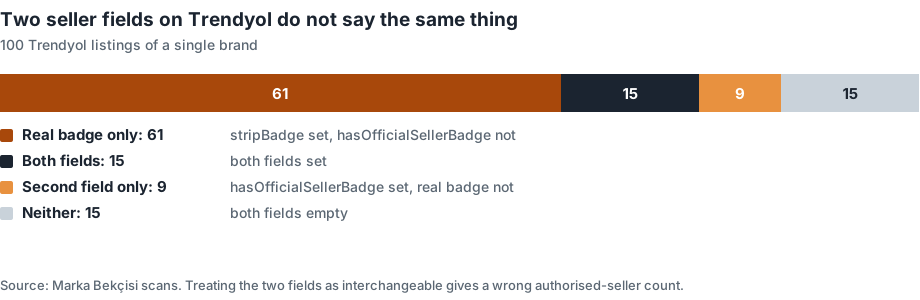
In our own measurement of 100 Trendyol listings for a single brand, the genuine authorised-seller badge appeared on 61 of them. The badge is printed when a document is approved, which makes the certificate visible in the listing itself. This visibility means buyers see the badge at the point of purchase, not just in a backend report. A brand owner who monitors only complaint outcomes misses the fact that the badge is the public signal of your authorisation decision. Tracking badge coverage across your catalogue shows exactly which sellers hold a current certificate and which do not.
More on this: how unauthorised sellers appear on Trendyol.
What the certificate has to carry
The certificate is issued by the brand owner. A document issued by a regional distributor does not, on its own, establish a chain back to the rights holder unless the distributor's own authority is documented alongside it. Marketplaces verify the link between the seller and the intellectual property right. A distributor's letter without the brand owner's backing leaves that link broken. Brand owners must issue the certificate directly or attach the distributor's written authorisation from the brand owner. Without this chain, the marketplace will reject the document.
Naming the seller as a legal entity matters more than naming a store. Marketplace store names change; the entity behind them is what a document can bind. A certificate that references only a storefront name loses its effect the moment the seller renames the shop. The legal entity — limited company, joint-stock company or sole trader — remains constant across rebrands. Brand owners should record the exact trade name, tax number and MERSIS number on the certificate. This precision prevents a seller from claiming authorisation under a new store identity.
| Field | Why it matters | Failure it prevents |
|---|---|---|
| Issuer, with legal entity name | Shows the certificate comes from the right holder | A certificate issued by an intermediate link |
| Named seller, with legal entity name | Ties the authority to one entity | A certificate that any reseller can present |
| Trademark and product scope | Limits which goods are covered | Authority spreading to unrelated products |
| Channels covered | States whether marketplaces are included | A dealer arguing offline authority covers online sales |
| Validity period | Makes the authority expire | An old dealer relying on a certificate forever |
| Signature and stamp | Formal validity | The most common rejection reason |
A validity period is what lets you end an authority without a dispute. A certificate with no end date keeps working for a former dealer long after the commercial relationship has ended. Open-ended documents create a permanent authorisation that survives contract termination. The brand owner then has no administrative tool to revoke marketplace access. An explicit expiry date or a clause tying validity to the distribution agreement gives a clean cut-off. Brand owners should align the certificate end date with the commercial contract end date.
Missing signature or stamp is the most frequent formal reason a document is rejected on a marketplace, followed by an expired document and a document not issued by the brand owner. Marketplaces apply a strict formal check before they assess commercial substance. An unsigned PDF, a scan without a wet-ink signature or a missing company stamp triggers an automatic rejection. An expired validity date produces the same result even if the commercial relationship continues. Brand owners must treat the certificate as a controlled document with a sign-off checklist.
State the channels explicitly. A dealer authorised for physical retail will otherwise argue that marketplace sales were covered too, and the marketplace has no way to tell. Silence on sales channels creates ambiguity that the seller exploits. The certificate must list each permitted channel: own website, Trendyol, Hepsiburada, Amazon.com.tr, n11, Çiçeksepeti, physical stores or any combination. A channel-specific certificate removes the marketplace's discretion and the seller's argument. Brand owners should issue a separate certificate or a clear annex for each channel set.
More on this: the 48-hour takedown rule and its five mandatory elements.
How it works on Trendyol in practice
Once your trademark registration is approved in the panel, other sellers of that brand are asked to produce documents, and listings from sellers who cannot upload them close after 36 hours. The clock starts when the request is issued, not when you first notice the seller. A seller who ignores the request loses the listing automatically, but a seller who responds with valid paperwork keeps the listing live. You cannot accelerate the 36-hour window by contacting support. The only lever you control is the accuracy of your own approved-supplier list before the request goes out.
Trendyol does not remove a listing merely because the seller is absent from your list. A seller who documents its supply keeps selling, which is exactly consistent with Article 152 of Law No. 6769 on exhaustion of rights. This means a genuine product sourced outside your authorised network remains legal to sell on the platform. Filing an intellectual-property complaint against that seller will be rejected because the goods are not counterfeit. The correct response is to add the seller to your authorised list or negotiate a distribution agreement that brings them inside your network.
The panel path is Ürün > Belge ve Tescil İşlemleri > Marka Tescil İşlemleri, and the approved-supplier screen is called İzin Verdiğim Tedarikçiler, where sellers are added by store link rather than by seller ID. You must copy the full store-front URL from the seller's public Trendyol page and paste it into the form. Entering a numeric seller ID, a tax number or a company name will not work. The store link is the only identifier the system accepts, so verify the link opens the correct shop before you submit.
A seller whose authorised seller status is approved for a brand and category is exempted from the originality check in that scope. The exemption applies only to the specific brand-category pair you approved. If the same seller lists the brand in a different category, the originality check runs again unless you extend the approval. Do not assume a blanket exemption across the entire catalogue. Check the category tree in the panel to confirm the exact scope of each approval.
If your document is rejected five times for the same brand, a one-month waiting period applies. Trial and error has a real cost, so fix the document before re-uploading it. Each rejection counts toward the five-attempt limit regardless of the reason given. Common causes are blurred stamps, mismatched company names or missing signature pages. Prepare a clean, complete PDF on the first attempt to avoid locking yourself out for thirty days.
More on this: how many sellers is normal for a brand in Turkey.
The commercial decision behind the document
Issuing the certificate widely makes enforcement impossible because everyone can document a chain, so nothing closes. When every seller holds a valid certificate, the marketplace has no basis to distinguish authorised from unauthorised listings. A broad issuance policy therefore removes the practical lever you rely on to trigger takedowns. The trade-off is commercial, not legal: you decide how many sellers you want to manage versus how much control you retain. Brand owners often assume that more certificates mean more protection, but the opposite is true in practice.
Issuing it narrowly concentrates volume in fewer sellers, which is a commercial trade-off rather than a legal one. A limited pool of authorised dealers makes it easier to identify listings that fall outside your network. Marketplace review teams can then act on the gap between your authorised list and the live offers. This approach sacrifices distribution breadth for enforcement clarity. The decision rests on your sales strategy, not on a statutory requirement.
Ending an authority needs its own document. A written revocation, sent to the dealer and dated, is what lets you tell a marketplace that a certificate presented later is no longer valid. Without a dated revocation, the dealer can continue to upload the old certificate and the platform will accept it as current proof. The revocation letter becomes the evidence that the authorisation chain is broken. Brand owners frequently forget to issue this document when a relationship ends, leaving a dormant certificate in circulation. A simple signed notice, delivered and dated, closes that gap.
What you may restrict in a dealer agreement is governed by competition law. Imposing a fixed or minimum resale price on independent sellers is prohibited in Turkey, and a recommended price cannot be made binding. Clauses that set a floor price or penalise discounting expose the agreement to invalidity and fines. The certificate itself does not override these rules; it merely proves the dealer’s status. Many brand owners draft price-control clauses assuming the authorised relationship permits them, but the law treats independent dealers as separate undertakings.
Channel and quality criteria are a different question from price and are assessed under the vertical agreements framework. Take specialist advice before drafting; this guide is not legal advice. Restrictions on where or how a dealer sells — such as online-only bans or marketplace exclusivity — fall under a separate analytical block. The competition authority evaluates these under the vertical block exemption criteria. A clause that is lawful for price may be unlawful for channel, and vice versa. Drafting them without specialist input risks unenforceable terms.
None of this replaces a lawyer or a trademark attorney. What it does is show which document the marketplace will actually look at when the objection arrives. The platform’s compliance team checks for a valid certificate and a valid revocation; they do not adjudicate your distribution agreement. Your legal counsel ensures the agreement survives scrutiny; the certificate ensures the takedown request is processed. Confusing the two roles leads to enforceable contracts that marketplaces ignore, or valid certificates that contracts undermine.
More on this: how to find every seller of your brand in Turkey.
Before you issue anything, know who is out there
A certificate policy written without a seller list is written blind. You cannot decide who to authorise until you know who is already selling. Issuing certificates to a handful of known distributors while dozens of unrecognised sellers remain active leaves the bulk of your marketplace presence unmanaged. The certificate then covers only a fraction of actual sales channels. Brand owners often assume their distribution map matches the live marketplace, but the two rarely align without verification.
Across 44 brands we scanned on five Turkish marketplaces, the median number of distinct sellers behind brand-matched listings was 32.5, and the middle half sat between 16 and 41. This scale surprises most brand owners who expect to see only their appointed partners. A median above thirty means the typical brand faces a seller landscape far larger than its authorised network. Readers often dismiss this figure as an outlier, yet it represents the central tendency across a diverse sample.
A high seller count is not evidence of infringement on its own; a wide and healthy distribution produces one too. The number that matters is how many of those sellers you recognise. Treating every unknown seller as a counterfeiter wastes enforcement resources on legitimate parallel importers or authorised sub-distributors. The operational task is identification, not assumption. Brand owners frequently conflate volume with violation, leading to misdirected takedown requests.
Marketplace lists go stale quickly as sellers appear and disappear, so a one-off list is worth less than a repeated one. A snapshot taken today will miss sellers who launch tomorrow and retain sellers who exited yesterday. Certificates issued against an outdated list authorise the wrong entities. Readers often treat a single audit as a durable foundation for policy, but the underlying data decays continuously.
Scanning five Turkish marketplaces by hand takes days. Producing and refreshing that list is the work we do. Manual collection across Trendyol, Hepsiburada, Amazon.com.tr, n11 and Çiçeksepeti consumes internal resources that could be directed at decision-making. Automated, repeated scanning turns a static burden into a live input for certificate management. Brand owners frequently underestimate the labour required to maintain an accurate seller register.
If you would rather not count these by hand, we run the scan across all five marketplaces and send the report free: free scan.
Frequently asked questions
Who issues an authorised dealer certificate?
The brand owner issues the authorised dealer certificate. A document issued by a regional distributor does not, on its own, establish a chain back to the rights holder unless the distributor's own authority is documented alongside it, and marketplace reviews check exactly that chain.
Why does the certificate matter more than a complaint?
The certificate matters more than a complaint because of the objection route. Under the Turkish e-commerce regulation a seller can get a removed listing reinstated within 24 hours by documenting a supply chain back to the rights holder, and the marketplace's review is limited to those documents. The certificate is the top link of that chain and you decide who holds it.
What makes a certificate fail on a marketplace?
A certificate fails on a marketplace most often due to a formal defect: a missing signature or stamp, an expired document, or a document not issued by the brand owner. On Trendyol, five rejections for the same brand trigger a one-month waiting period, so it is cheaper to correct the document than to resubmit it.
Can I set the resale price in the same document?
You cannot set the resale price in the same document. Imposing a fixed or minimum resale price on independent sellers is contrary to Turkish competition law and a recommended price cannot be made binding. Channel and quality criteria are assessed under a different framework; take specialist advice before drafting.
How do I withdraw an authority I already granted?
You withdraw an authority you already granted with a written, dated revocation sent to the dealer. That document is what lets you tell a marketplace that a certificate presented afterwards is no longer valid, and it is also the reason every certificate should carry a validity period from the start.
Sources
- Regulation on Electronic Commerce Intermediary Service Providers and Electronic Commerce Service Providers — Official Gazette 29 December 2022, no. 32058 — objection documents in art. 13, reinstatement within 24 hours in art. 14
- Industrial Property Law No. 6769 — full text (PDF, Turkish) — Article 152, exhaustion of rights: resale of goods put on the market with the right holder's consent falls outside the scope of the right
- Trendyol Seller Information Centre — Authorised Seller Process (Turkish) — Conditions for the authorised seller document and the reasons it is rejected
- Trendyol Seller Information Centre — Trademark Registration Process (Turkish) — Document requests to other sellers after approval and the 36-hour window
- Turkish Competition Authority — Guidelines on Vertical Agreements (PDF, Turkish) — Framework on resale price maintenance and restrictions in distribution systems
- Turkish Patent and Trademark Office — Trademarks (Turkish) — Registration record establishing who the right holder is in Turkey
Related guides
Grey Market and Parallel Imports in Turkey: Why Unauthorised Sellers Are Often Legal (2026)
A seller with no contract with you is usually not infringing. What exhaustion of rights under Turkish IP law means, and what actually removes them.
7 September 2026 · 15 minHow Many Sellers Is Normal on Turkish Marketplaces? A 44-Brand Benchmark (2026)
We scanned 44 brands across five Turkish marketplaces: median 32.5 sellers, middle half 16-41, most fragmented 79. Compare your own number.
22 September 2026 · 11 minTrendyol's Approved Suppliers List: How Brand Owners Control Distribution (2026)
Trendyol does not delete listings from sellers off your list. It asks them for documents, and those who cannot produce them close after 36 hours.