Trendyol's Approved Suppliers List: How Brand Owners Control Distribution (2026)
Muhammet Çay · 22 September 2026 · 11 min read
Short answer: Trendyol has no single screen called a brand protection programme. What exists is a set of panel screens, and the two that matter are the trademark registration record and the approved-supplier list, called İzin Verdiğim Tedarikçiler, where sellers are added by store link rather than by seller ID. The mechanism is the part most often described wrongly: Trendyol does not delete the listing of a seller who is absent from your list. Once your trademark record is approved, other sellers of that brand are asked to produce an authorised-seller document, and listings from sellers who cannot upload one close after 36 hours. A seller who can document its supply keeps selling, which is consistent with the exhaustion of rights principle in Turkish law. Filling that list therefore requires knowing who is selling first.
What the approved-supplier list actually does
There is no single Trendyol screen called a brand protection programme. The real screens are the trademark registration record, the approved-supplier list, the authorised seller process, infringement notices and the originality check. Brand owners who expect one dashboard to manage every enforcement action will not find it. Each screen serves a separate procedural step and must be opened individually. Treating them as a single programme causes missed deadlines and incomplete evidence packages.
The approved-supplier list is called İzin Verdiğim Tedarikçiler and it is where a brand owner names the sellers it authorises. Only sellers entered on this list are recognised as authorised by Trendyol's internal workflows. The list is managed inside the trademark registration record, not in a separate brand-protection menu. A brand owner who skips this screen leaves every seller of its products in an unverified state.
Being absent from that list does not, by itself, remove a seller's listing. This is the single most misunderstood point, and planning around the wrong assumption wastes the whole quarter. Many brand owners assume that an unlisted seller is automatically blocked, so they stop monitoring those listings. In reality the listing stays live until a document check is triggered and the seller fails to respond.
What absence does is trigger a document request. Sellers of your brand are asked to produce an authorised-seller document, and those who cannot upload one have their listings closed after 36 hours. The request is sent automatically by Trendyol when a seller not on the approved-supplier list attempts to list your brand. The seller must upload a valid authorisation letter or distribution agreement within the 36-hour window. If the document is accepted, the listing remains active; if it is missing or rejected, the listing is closed.
A seller who can document its supply keeps selling. That is consistent with Article 152 of Law No. 6769: resale of goods put on the market by the right holder or with consent cannot be blocked on trademark grounds alone. The platform cannot remove a listing solely because the seller is not on your approved-supplier list if the seller proves a legitimate supply chain. Brand owners who want tighter control must use contractual distribution agreements and authorised-dealer certificates, not the approved-supplier list alone.
More on this: how unauthorised sellers appear on Trendyol.
Setting up the trademark record first
Everything begins with the trademark record. Until it is approved, no document is requested from anyone and the 36-hour closure mechanism never starts. This means you cannot submit takedown requests or whitelist authorised sellers before the record clears. A common mistake is preparing complaint files while the record is still pending, which wastes time because the system will not accept them.
The panel path is Ürün > Belge ve Tescil İşlemleri > Marka Tescil İşlemleri. Third-party articles that name a different path are describing a screen that does not exist. Following an outdated path leads you to a dead end or an unrelated menu. Always navigate using the exact Turkish labels above to reach the correct submission form.
| Step | Where | Timing | Trap |
|---|---|---|---|
| Upload the trademark certificate | Ürün > Belge ve Tescil İşlemleri > Marka Tescil İşlemleri | 36-hour review window | Five rejections trigger a one-month wait |
| Add authorised sellers | İzin Verdiğim Tedarikçiler | After approval | Sellers are added by store link, not seller ID |
| Document request to other sellers | Automatic | Listings close after 36 hours | Sellers who document their supply keep selling |
| Authorised seller badge | Listing page | After the document is approved | Absence of a badge is not evidence of infringement |
| Infringement notice | İhlal Bildirimleri | 36-hour review | Up to 10 links for trademark, 5 for image or design |
If the document is rejected five times for the same brand, a one-month waiting period applies. The common rejection reasons are an expired document, a missing signature or stamp, and a document not issued by the brand owner. Each rejection counts toward the five-attempt limit, so resubmitting the same defective file accelerates the lockout. Verify the expiry date, signature block and issuing authority before every upload.
The review runs to a 36-hour window. This is Trendyol's own timing and it is separate from the 48-hour removal period the e-commerce regulation sets for compliant complaints. The 36 hours apply only to the trademark record approval decision. Do not confuse this with the later takedown deadline, which is governed by a different legal framework.
Your Turkish trademark record is what establishes the right. A registration held only in your home country does not give a Turkish marketplace something to act on. Trendyol requires a valid Turkish registration or an international registration designating Turkey. Relying on a foreign certificate alone will result in immediate rejection.
| Rejection reason | Practical check before upload |
|---|---|
| Expired document | Confirm the certificate expiry date is in the future. |
| Missing signature or stamp | Ensure the authorised signatory has signed and the company stamp is visible. |
| Not issued by the brand owner | The document must originate from the rights holder, not a distributor or agent. |
More on this: how to find every seller of your brand in Turkey.
Adding sellers by store link
Sellers are added to the approved-supplier list by store link rather than by seller ID. Collect the store links while you are building your seller list, not afterwards. A seller ID is an internal marketplace identifier that you cannot verify from the public storefront. The store link is the stable, public address that both you and the marketplace can reference without ambiguity. If you wait until after the monitoring phase to gather links, you will have to revisit every product page a second time, which doubles the manual effort.
The list can only be filled from a list you already hold. Deciding who is authorised requires knowing who is currently selling, which is a separate piece of work. You cannot use the approved-supplier tool to discover your distribution network; it only records the decisions you have already made. Many brand owners open the form expecting a searchable directory of active sellers and find an empty input field instead. Treat the authorised-dealer audit as a prerequisite project with its own timeline and owner.
Across 44 brands we scanned on five Turkish marketplaces the median number of distinct sellers was 32.5, with the middle half between 16 and 41. A brand with 30 sellers is not unusual. This volume means a spreadsheet review is not a five-minute task; it requires a structured workflow with status columns for "recognised", "unrecognised" and "pending verification". Teams that underestimate the count often rush the classification and leave authorised dealers off the list by mistake.
A high seller count is not evidence of infringement. What matters is how many of those sellers you recognise and how many appear on your own dealer list. Marketplace algorithms reward assortment depth, so legitimate brands naturally accumulate dozens of resellers over time. Flagging a store solely because the total number looks large wastes review capacity and creates friction with genuine partners. Focus the investigation on the gap between the marketplace seller set and your authorised-dealer register.
Keep the list alive. Removing a dealer whose authority has ended matters as much as adding a new one, because a stale list quietly re-authorises someone you no longer supply. A distribution agreement termination does not automatically notify the marketplace; the store link remains on the approved list until you delete it. Schedule a quarterly reconciliation between your ERP dealer master data and the marketplace approved-supplier list to catch revocations before they become blind spots.
More on this: how many sellers is normal for a brand in Turkey.
What happens to sellers who are not on the list
Once your trademark record is approved, other sellers of the brand are asked to produce documents, and listings from those who cannot upload one close after 36 hours. This automated deadline means the window for a seller to react is extremely short. A brand owner should not expect a manual review or an extension once the timer starts. The closure applies to the specific listing that failed to provide the document, not necessarily the seller’s entire account. Monitoring the brand’s search results 48 hours after approval gives a reliable picture of which listings have been removed.
Sellers who upload an approved authorised-seller document keep selling and are exempted from the originality check for that brand and category. The exemption is tied to the specific brand and category combination covered by the document. A seller authorised for footwear does not receive a blanket pass for apparel under the same trademark. Brand owners should verify that each category they care about is included in the authorised-seller certificates they collect from distributors. Missing a category leaves a gap where unauthorised listings can remain active without triggering the originality check.
The authorised seller badge on a listing shows that a document was approved. Its absence means the document was never uploaded, was rejected, or the brand does not run this flow at all — none of which is proof of infringement. A missing badge is a signal to investigate, not a basis for an IP complaint. Sellers of genuine goods who lack the badge may simply be waiting for a distributor to issue the certificate. Treating every badge-less listing as counterfeit wastes enforcement resources and risks wrongful takedown claims.
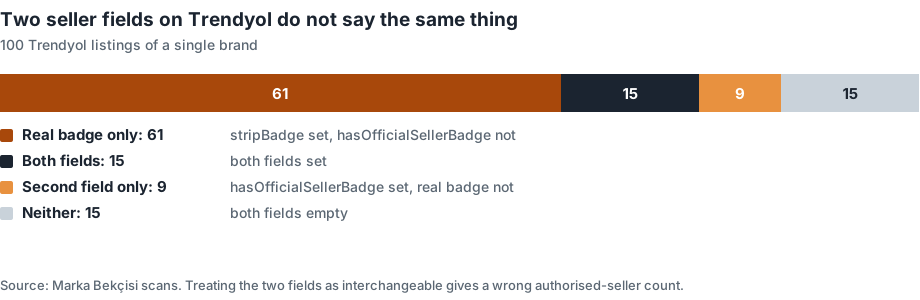
In our own measurement of 100 listings for a single brand, the genuine authorised-seller badge appeared on 61. Badge fields are not interchangeable and a weaker field should not be read as authorisation. The 39 listings without the badge included a mix of rejected documents, pending uploads, and sellers outside the authorised network. Relying on a different trust indicator, such as a “Trusted Seller” label, does not substitute for the authorised-seller badge. Brand owners must filter specifically for the authorised-seller field when auditing marketplace coverage.
Buybox eligibility runs on the same logic: goods must be sourced from the trademark owner recorded with the Turkish Patent and Trademark Office, or from an authorised seller. A listing without an approved document will not win the buybox even if it offers the lowest price. This mechanic protects authorised sellers from price undercutting by unauthorised sources. Brand owners who want to control the buybox should ensure their authorised distributors upload valid certificates promptly.
More on this: the 48-hour takedown rule and its five mandatory elements.
Where the list does not help
The approved-supplier list is a Trendyol mechanism. It changes nothing on Hepsiburada, Amazon.com.tr, n11 or Çiçeksepeti, each of which has its own route. You must open a separate process on every other marketplace where you sell. A whitelist granted on Trendyol has no legal or technical effect on a competitor platform. Assuming cross-platform coverage is the most common error brand owners make after securing the badge.
It does not address counterfeits directly either. A counterfeit seller who cannot document supply will be closed by the document request, but a determined counterfeiter relisting under a new store is a separate, recurring problem. The list filters sellers who cannot prove a legitimate supply chain at the moment of application. It does not prevent a bad actor from opening a fresh storefront next week with fabricated invoices. Treating the approved-supplier list as an anti-counterfeit shield leaves a gap that persistent infringers exploit.
For counterfeits the route is a complaint under the e-commerce regulation, with its five mandatory elements, and removal within no more than 48 hours on a compliant filing. You must assemble the specific evidence package the regulation demands before the platform is obliged to act. Missing a single mandatory element resets the clock and delays the takedown. Relying on the approved-supplier workflow for counterfeit removal wastes the statutory 48-hour window.
Infringement notices have their own limits: up to 10 links for a trademark claim and 5 for image or design, with a 36-hour review. You cannot bundle unlimited URLs into a single notice; the platform will reject or truncate an oversized filing. Each notice type carries a different link cap, so a mixed claim requires separate submissions. Expecting one bulk notice to clear an entire catalogue of infringing listings contradicts the published limits.
None of these tools tells you which sellers exist. Scanning five Turkish marketplaces by hand takes days and the result goes stale within weeks; producing and refreshing that list is the work we do. The approved-supplier list, the e-commerce complaint form and the infringement notice portal are reactive instruments. They assume you already know the target store URL. Without a current, marketplace-wide seller map you are filing blind against the most visible offenders while unknown sellers continue trading.
If you would rather not count these by hand, we run the scan across all five marketplaces and send the report free: free scan.
Frequently asked questions
Does Trendyol remove sellers who are not on my approved-supplier list?
Once your trademark record is approved, other sellers of the brand are asked to produce an authorised-seller document, and listings from sellers who cannot upload one close after 36 hours. A seller who documents its supply keeps selling, which is what Turkish law on exhaustion of rights requires.
How do I add a seller to the approved-supplier list?
In the screen called İzin Verdiğim Tedarikçiler, using the seller's store link rather than its seller ID. Collect those store links while you are building your seller list, because the list can only be filled from information you already hold.
What happens if my trademark document keeps getting rejected?
After five rejections for the same brand a one-month waiting period applies, and during it no document is requested from other sellers, so the whole mechanism stalls. The usual causes are an expired document, a missing signature or stamp, or a document not issued by the brand owner.
Is a missing authorised seller badge proof that a seller is unauthorised?
The badge appears when a document has been approved, so its absence can mean the document was never uploaded, was rejected, or that the brand does not use this flow at all. None of those is proof of infringement, which is why we describe such listings as candidates for review.
Does this work on the other Turkish marketplaces?
The approved-supplier list is specific to Trendyol. Hepsiburada takes rights-holder filings only by notary or KEP, n11 requires membership of its own brand protection centre, Çiçeksepeti has no brand-owner portal, and Amazon runs its own brand registry.
Sources
- Trendyol Seller Information Centre — Trademark Registration Process (Turkish) — Panel path, the 36-hour window, and the one-month wait after five rejections
- Trendyol Seller Information Centre — Authorised Seller Process (Turkish) — Conditions for the authorised seller document and why it is rejected
- Trendyol Seller Information Centre — Originality Check (Turkish) — Sellers approved as authorised for a brand and category are exempt from the originality check
- Trendyol Seller Information Centre — Infringement Notices (Turkish) — Up to 10 links for trademark and 5 for image or design; 36-hour review; seller-based trademark infringement notice
- Trendyol Seller Information Centre — Buybox Eligibility Rules (Turkish) — Requirement that goods be sourced from the trademark owner recorded with the Turkish Patent and Trademark Office, or from an authorised seller
- Industrial Property Law No. 6769 — full text (PDF, Turkish) — Article 152, exhaustion of rights
- Regulation on Electronic Commerce Intermediary Service Providers and Electronic Commerce Service Providers — Official Gazette 29 December 2022, no. 32058 — complaint, objection and reinstatement
Related guides
The Authorised Dealer Certificate in Turkey: What It Does and How to Issue It (2026)
The certificate the brand owner issues decides who stays on a Turkish marketplace. Why objections turn on it, the fields it must carry and how it fails.
7 September 2026 · 15 minHow Many Sellers Is Normal on Turkish Marketplaces? A 44-Brand Benchmark (2026)
We scanned 44 brands across five Turkish marketplaces: median 32.5 sellers, middle half 16-41, most fragmented 79. Compare your own number.
6 September 2026 · 10 minSomeone Is Selling My Brand on Trendyol: What a Foreign Brand Owner Can Actually Do (2026)
How Trendyol's trademark mechanism really works for brand owners: the 36-hour document rule, the Suppliers I Authorize list, the Authorized Seller badge, notice limits, and why genuine goods sold by a non-dealer are not a takedown case under Turkish law.