How Many Sellers Is Normal on Turkish Marketplaces? A 44-Brand Benchmark (2026)
Muhammet Çay · 7 September 2026 · 15 min read
Short answer: There is no single correct number, but there is a benchmark. Across 44 brands we scanned on Trendyol, Hepsiburada, Amazon.com.tr, n11 and Çiçeksepeti, the distinct sellers behind brand-matched listings ranged from 1 to 79, with a median of 32.5. The middle half of brands sat between 16 and 41 sellers. So 30 to 40 sellers is not abnormal on its own. The question that matters is not the count: it is how many of those sellers you recognise, how many appear on your authorised-dealer list, and where they source the product. A high count is not evidence of infringement; a wide, healthy distribution produces one too.
What the number tells you, and what it does not
A high seller count is not evidence of infringement on its own. A wide and healthy distribution network produces a high count too. You cannot assume that every listing represents a violation of your rights. The marketplace model encourages multiple merchants to list the same ASIN or product page. Treating the raw number as a risk score leads you to waste enforcement budget on legitimate resellers. Your next step is to segment the list into recognised and unrecognised sellers before you take any action.
Under Article 152 of Industrial Property Code No. 6769, exhaustion of rights means goods put on the market by the right holder or with their consent cannot be blocked from resale on the basis of the trade mark right. This provision applies once genuine products have entered the Turkish market with your permission. An intellectual-property complaint against a seller of genuine goods will be rejected by the platform. The remedy for unauthorised-but-genuine sales is a commercial one: an authorised-dealer certificate, a marketplace whitelist, or a distribution agreement. You must adjust your enforcement playbook to distinguish between counterfeit listings and parallel imports.
The count becomes meaningful only when you know how many of those sellers you recognise. The share of unrecognised sellers is more informative than the count itself. A brand with fifty sellers and forty-eight authorised partners has a different problem from a brand with fifty sellers and two authorised partners. Calculate the unrecognised ratio each time you audit a marketplace. That ratio tells you whether you have a leakage issue or a counterfeit issue. It also gives you a baseline to measure the impact of any distribution tightening.
Most brand owners have never measured this number; they discover the situation only when a distributor complains. Reactive discovery means you are always behind the curve. A scheduled quarterly audit of seller counts across Trendyol, Hepsiburada, Amazon.com.tr, n11 and Çiçeksepeti turns the metric into an early-warning system. Assign the audit to a specific team member with a fixed calendar slot. The first audit will take longer because you must build the authorised-seller master list; subsequent audits become a simple comparison.
For a foreign brand, the count is usually higher than expected because the Turkish grey market is supplied through parallel imports that never appear in the brand's own distributor records. Parallel importers buy genuine stock in other European markets and bring it into Turkey through customs. Your European distribution agreements do not cover these flows. The sellers look like unknown merchants, but they are selling authentic product. You cannot remove them with a trade mark notice. You must address the source market leakage through your upstream distributors and contractual controls.
More on this: how to list every seller of your brand in Turkey.
The benchmark: 44 brands, five marketplaces
We scanned 46 brands across Trendyol, Hepsiburada, Amazon.com.tr, n11 and Çiçeksepeti; 44 of them returned brand-matched listings and a seller count could be calculated. Two brands produced no matched listings at all, which means they either have no active distribution in Turkey or their products are listed under names our matching logic does not recognise. For a brand owner, this confirms that absence from the scan is itself a signal: either the brand is not yet distributed here, or the catalogue data needs cleaning before any enforcement programme begins. The next step is to verify whether those two brands should appear in Turkey at all, and if so, to correct the feed or trademark record that prevents matching. A reader typically assumes zero listings equals zero risk, but it may only mean zero visibility.
In total 10,182 brand-matched listings and 937 distinct sellers were recorded. The listing count reflects every active SKU that carried the brand name on the five marketplaces at the moment of the scan. The seller count is the number of unique merchant accounts behind those listings, de-duplicated where identity data exists. For a brand owner, the ratio of roughly eleven listings per seller shows that most merchants carry a narrow slice of the catalogue rather than the full range. This changes the next step: you do not need to engage 937 counterparties to cover the assortment; you need to identify the few dozen sellers who hold the bulk of the listings. A reader typically gets wrong the idea that every seller requires a separate legal notice; commercial leverage concentrates on the top volume accounts.
| Band | Sellers | What it means |
|---|---|---|
| Minimum | 1 | The narrowest distribution we scanned |
| Lower quartile (25%) | 16 | A quarter of brands sit below this |
| Median | 32.5 | The middle brand |
| Upper quartile (75%) | 41 | A quarter of brands sit above this |
| 90th percentile | 57 | Above this is the most fragmented 10% |
| Maximum | 79 | The most fragmented brand we scanned |
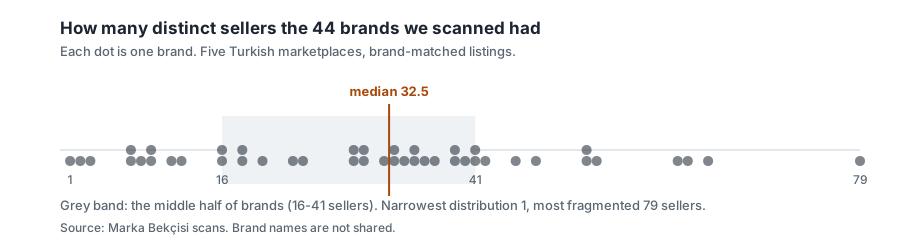
Seller counts ranged from 1 to 79, with a median of 32.5. The brand with a single seller likely operates an exclusive distribution model or has only recently entered the market. The brand with 79 sellers sits at the extreme of open distribution where practically any merchant can list. For a brand owner, the median tells you that a "normal" Turkish footprint involves roughly thirty active merchant accounts across the major platforms. If your brand shows five sellers, you are unusually tight; if it shows sixty, you are unusually open. The next step is to place your own brand on this spectrum before deciding whether the current breadth matches your strategy. A reader typically gets wrong the assumption that fewer sellers always means better control; a single unauthorised seller can do more price damage than thirty authorised ones.
The lower quartile is 16 sellers and the upper quartile is 41, so the middle half of brands sit between 16 and 41. This interquartile range defines the zone where most established brands operate without extreme restriction or total fragmentation. For a brand owner, falling inside this band means your seller count is typical for the market; you do not have an outlier problem based on volume alone. The next step is to check seller identity rather than seller count: are those 16 to 41 accounts your authorised partners, or are they grey-market importers? A reader typically gets wrong the belief that a "normal" count equals a healthy channel; the composition of the list matters more than its length.
The 90th percentile is 57 sellers: above that a brand is in the most fragmented tenth of the pool we scanned. Brands crossing this threshold face a coordination problem that is qualitatively different from the median case. For a brand owner, exceeding 57 sellers usually means marketplace onboarding has outpaced contractual control, or that a popular product line has attracted opportunistic resellers faster than the distribution agreement can be enforced. The next step is to prioritise a whitelist or authorised-dealer certificate rollout before the seller base grows further. A reader typically gets wrong the response of filing mass IP complaints; against genuine goods, exhaustion of rights under Article 152 of the IP Code makes that route ineffective.
Seller identity is only readable on Trendyol and Hepsiburada, so counts are de-duplicated from those two marketplaces; Amazon, n11 and Çiçeksepeti seller identities are not collected. The real number can therefore be higher than the figure shown, never lower. This methodological limit means every seller count in this benchmark is a floor, not a ceiling. For a brand owner, you must treat the reported figure as the minimum number of distinct merchants you are dealing with. The next step is to request seller-identity reports from Amazon, n11 and Çiçeksepeti through their brand-protection portals, or to use a monitoring service that correlates listings across platforms by SKU and price pattern. A reader typically gets wrong the assumption that the published number is the final answer; it is the starting point for a deeper audit.
How many sellers does your brand have?
Shows where you sit in the seller distribution of the 44 brands we scanned across five Turkish marketplaces. The number you type never leaves your browser.
1median 32.579
| Fewest of the brands we scanned | 1 seller |
| Lower quartile (25%) | 16 sellers |
| Median | 32.5 sellers |
| Upper quartile (75%) | 41 seller |
| Most fragmented brand | 79 sellers |
This is not a measure of infringement. A high count can mean a wide and healthy distribution. The number only tells you how many separate parties sit on your product page and how many of them you recognise. If you cannot answer that, the problem is visibility, not the count.
More on this: what a foreign brand owner can actually do on Trendyol.
The badge ratio: zero on 16 of 42 brands
Of the 42 brands with matched listings on Trendyol, 16 — that is 38 per cent — carried no Authorised Seller badge on a single listing. This means that for more than a third of the brands in the benchmark, the marketplace displayed no visual signal of authorised distribution on any product page. A brand owner seeing this result should not assume that every seller is unauthorised. The figure only shows that the badge mechanism has not produced a positive result for any listing. The next step is to check whether the brand has ever submitted an authorised-dealer certificate through the Trendyol panel. If no certificate has been uploaded, the zero ratio is an administrative gap, not a market problem.
The absence of the badge is not evidence of infringement. Trendyol prints that badge according to an authorised-dealer certificate the seller uploads and that is then approved; the certificate may never have been uploaded, may have been rejected, or the brand may not use the flow at all. A common mistake is to treat a missing badge as proof that a seller is violating trademark rights. Turkish law recognises exhaustion of rights for genuine goods placed on the market with the brand owner's consent, so an IP complaint against a genuine reseller will be rejected. The correct response is to verify whether the seller holds a valid certificate and, if not, to decide whether the brand wants to formalise the relationship or restrict supply.
Recorded reasons for rejection include an expired certificate, a missing signature or company stamp, and a certificate not obtained from the brand owner. These rejections are administrative and do not reflect on the authenticity of the goods. A brand owner who receives a rejection notice should correct the document and resubmit it rather than escalating to legal channels. The marketplace will not activate the badge until the certificate meets the formal requirements. Until that happens, authorised sellers operate without the badge and unauthorised sellers face no additional scrutiny.
In practice a zero badge ratio means the mechanism that decides who may sell on your product page has never been set up. Until the trade mark registration is defined in the panel, the marketplace never starts asking other sellers for documents. This is the most consequential finding for a brand owner entering Turkey. Without a registered trademark in the panel, the brand has no access to the authorised-dealer flow, the whitelist, or the brand protection tools that depend on it. The immediate operational step is to register the Turkish trademark in the Trendyol brand panel and upload a valid authorised-dealer certificate for at least one seller.
More on this: the 48-hour takedown rule and its mandatory elements.
What to do when the count comes out high
The first step is de-duplication: the seller identifier in the listing link and the store link pin the seller even when the store name changes. A single operator often runs multiple storefronts that display different trading names while the underlying seller ID remains constant. You must extract that identifier from both the product listing URL and the store profile URL to collapse what looks like five sellers into one entity. Without this step your seller count is inflated and any enforcement list you build will contain duplicates. Marketplace dashboards rarely surface the identifier by default, so you need to pull it from the URL parameters or the page source. Treat the identifier as the primary key for every downstream decision.
The second step is verifying the trade name: take the company name from the seller information on the store page and confirm the business through the ETBİS registered-site lookup. The store page shows a commercial title that may be a brand, a trading style or an abbreviation rather than the legal entity. You copy that name exactly as displayed and query the ETBİS system to retrieve the registered company, tax number and address. A mismatch between the storefront name and the ETBİS record signals a data-quality issue you must resolve before you classify the seller. Many brand owners skip this verification and later discover they have been negotiating with a shell entity or a misspelled entry. The ETBİS record is the authoritative source for any legal correspondence or platform complaint.
The third step is matching: compare against your authorised-dealer list and separate the sellers that appear on it from those that do not. This is where the actual information is. You now have a de-duplicated, legally verified roster of sellers; you overlay your internal authorised-dealer register to flag every account that lacks a current agreement. Sellers on the authorised list are compliant by definition and require no further action unless their agreement has lapsed. Sellers absent from the list become your review queue for unauthorised distribution, parallel import or counterfeit risk. A common error is treating the raw seller count as the problem; the real metric is the unauthorised subset after matching.
The fourth step is the marketplace's own mechanism: on Trendyol the registration certificate is uploaded under Ürün > Belge ve Tescil İşlemleri > Marka Tescil İşlemleri, then the İzin Verdiğim Tedarikçiler list is filled in. You upload the Turkish trademark registration certificate through that menu path, then populate the authorised supplier list with the verified seller identifiers from the previous step. Once submitted, Trendyol reviews the registration and, upon approval, activates the brand-protection workflow for your catalogue. The authorised supplier list acts as a whitelist; any seller not on it will be challenged when they list your products. Incomplete or outdated supplier lists cause legitimate distributors to be blocked, so you must maintain the list after every contract change.
The Trendyol mechanism works like this: once the registration is approved, other sellers of the same product are asked for documents; sellers who cannot upload one have their products closed to sale after 36 hours, while a seller who does provide one carries on selling. After your registration is live, Trendyol automatically notifies every other seller listing your ASINs and requests a supply-chain document such as an invoice or authorisation letter. A seller who fails to upload a valid document within 36 hours sees those listings deactivated; a seller who supplies acceptable documentation continues without interruption. This automated challenge replaces manual takedown requests for the enrolled catalogue. Brand owners often assume the 36-hour window starts at their registration date, but it starts per seller at the moment they are challenged.
Against a seller of genuine goods an IP complaint is not the remedy; the remedy is an authorised-dealer certificate, a marketplace whitelist and a distribution agreement. Turkish IP Code article 152 exhausts the trademark owner's rights once genuine goods are placed on the market in Turkey with consent, so an intellectual-property takedown will be rejected for authentic products. The operational path is to onboard the seller through your authorised-dealer certificate, add them to the marketplace whitelist and formalise the relationship in a distribution agreement. Filing an IP complaint against a genuine-goods seller wastes platform goodwill and exposes you to counter-notification risk. Reserve IP complaints for counterfeit or materially different goods only.
More on this: where to send an IP complaint on each marketplace.
Measuring your own number
The manual method is to search each marketplace for your brand name and group the listings by seller. Across five marketplaces and hundreds of listings this takes hours, and it has to be repeated a week later. A single sweep across Trendyol, Hepsiburada, Amazon.com.tr, n11 and Çiçeksepeti can produce several hundred result pages that must be opened individually. You record the seller name shown on every product detail page and then consolidate the rows into a master list. The workload scales linearly with catalogue breadth, so a brand with fifty SKUs requires significantly more operator time than a brand with five. Scheduling this as a recurring calendar task prevents the measurement from being postponed until a crisis forces it.
The most common error in manual counting is counting the same seller more than once under different store names. De-duplicating on the seller identifier prevents this. A single legal entity often operates multiple storefronts that display distinct trading names on the marketplace front end. If you rely on the visible store name alone, one distributor can appear as three separate sellers and distort your benchmark comparison. The seller identifier — usually a numeric ID embedded in the store URL or API response — remains constant across those storefronts. Building your master list around that identifier rather than the display name keeps the count accurate and comparable over time.
Marketplace search is fuzzy: a search for your brand name also returns other brands' products. Listings have to be filtered down to those genuinely belonging to your brand before counting, otherwise the number is inflated. A query for a short or generic brand term frequently surfaces unrelated items that happen to contain the same character string in the title or description. Each result page must be inspected to confirm the product carries your trademark, your packaging codes or your authorised SKU list. Skipping this verification step adds phantom sellers to the tally and makes your distribution look wider than it really is. The extra review time is the price of a defensible number.
The measurement has to be repeated rather than done once: a new seller entering is only visible when two measurements are compared. A single snapshot tells you how many sellers are active today but reveals nothing about trajectory. Comparing the seller identifier list from week one with the list from week two highlights entrants and exits immediately. Without that delta you cannot distinguish a stable authorised network from one that is quietly expanding through grey channels. Setting a fixed interval — for example every seven days — creates a time series that supports trend analysis and early escalation.
For a foreign brand there is an extra step: the Turkish trade name on a store page rarely matches any name in your own distributor records, so verifying the business through ETBİS is not optional. The company name displayed on a Trendyol or Hepsiburada storefront is often a local operating entity, a fulfilment partner or a holding company that does not appear in your distribution agreements. Cross-referencing the Turkish trade registry (ETBİS) using the tax number or legal title from the seller page links the marketplace identity to the registered Turkish entity. That link lets you confirm whether the entity is your appointed distributor, a sub-distributor or an unauthorised party. Skipping the registry check leaves you guessing at the legal relationship behind every store name.
If you would rather not count these by hand, we run the scan across all five marketplaces and send the report free: free scan.
Frequently asked questions
How many sellers counts as too many?
There is no single threshold. In our benchmark the middle half of brands sit between 16 and 41 sellers, and above 57 a brand is in the most fragmented tenth. But the count alone is neither good nor bad — the share of sellers you do not recognise is the real measure.
Is a high seller count a trade mark infringement?
No. A seller of genuine goods cannot be blocked on the basis of the trade mark right, because of exhaustion of rights. Infringement only arises if the product is counterfeit or the mark is used without permission.
Does a missing Authorised Seller badge on Trendyol mean the seller is unauthorised?
No. The badge is printed according to a certificate the seller uploads and that is then approved. Its absence can mean the certificate was never uploaded, was rejected, or the brand does not use the flow at all — none of which is infringement.
Can I measure this myself?
Yes, by searching each of the five marketplaces for your brand name and grouping listings by seller. The difficulty is scale and repetition: hundreds of listings have to be de-duplicated on the seller identifier, and the exercise repeated at regular intervals.
Which brands are in the benchmark?
We do not publish the brand names. Every brand we scanned is a potential customer and the scan data belongs to them; only the aggregated, anonymous distribution is published.
Sources
- Industrial Property Code No. 6769 — full text (PDF, Turkish) — Article 152: acts concerning goods put on the market by the right holder or with their consent fall outside the scope of the right
- Regulation on E-Commerce Intermediary Service Providers and E-Commerce Service Providers — Official Gazette 29.12.2022, no. 32058 — complaint art. 12, objection art. 13, republication art. 14
- ETBİS — registered e-commerce site lookup — Used to verify the trade name shown on a seller's store page
- Trendyol Akademi — Seller Information Centre — Marka Tescil İşlemleri and İzin Verdiğim Tedarikçiler screens
Related guides
Grey Market and Parallel Imports in Turkey: Why Unauthorised Sellers Are Often Legal (2026)
A seller with no contract with you is usually not infringing. What exhaustion of rights under Turkish IP law means, and what actually removes them.
21 September 2026 · 12 minThe Authorised Dealer Certificate in Turkey: What It Does and How to Issue It (2026)
The certificate the brand owner issues decides who stays on a Turkish marketplace. Why objections turn on it, the fields it must carry and how it fails.
6 September 2026 · 9 minWho Is Selling My Brand in Turkey? How to List Every Seller on Trendyol, Hepsiburada, Amazon.com.tr, n11 and Çiçeksepeti (2026)
A step-by-step method for finding every seller of your brand on the five Turkish marketplaces: where the seller identity is visible, how to pin a seller down with Trendyol's merchantId, what the buy box does to your product page, and why a one-off list goes stale in weeks.