Grey Market and Parallel Imports in Turkey: Why Unauthorised Sellers Are Often Legal (2026)
Muhammet Çay · 7 September 2026 · 13 min read
Short answer: Under Article 152 of Turkish Industrial Property Law No. 6769, acts concerning goods put on the market by the right holder or with the right holder's consent fall outside the scope of the trademark right. In plain terms: once a genuine unit has legitimately entered the market, reselling it cannot be blocked on trademark grounds alone. Having no contract with the seller is not, by itself, infringement. This is why IP complaints against grey-market listings usually fail: the seller replies with an invoice and a supply chain traced back to the right holder, and the regulation requires the listing to go back up within 24 hours. What works is not complaint but distribution control: an authorised-dealer certificate, the marketplace's approved-supplier list, and channel terms in your dealer agreements.
Grey market is not counterfeit, and the difference decides your options
A grey-market listing offers a genuine unit that reached the marketplace outside the distribution channel the brand owner built. The product is real; the problem is the route it travelled, not the goods. This means the physical item in the buyer's hands matches your specifications and quality standards. You cannot claim the goods are fake or unsafe based on the listing alone. Treating the listing as a counterfeit case wastes the legal tools reserved for fake products.
A counterfeit listing offers goods the right holder never made, carrying the mark without permission. These are two different legal situations with two different remedies, and separating them is the first thing to do with any listing you find. Counterfeit complaints trigger intellectual property enforcement routes that require proof of unauthorised manufacture. Grey-market complaints rely on distribution agreements and selective distribution criteria. Mixing the two frameworks leads to the wrong evidence being submitted to the marketplace.
Parallel import means the unit was put on the market in one country and then brought into Turkey and sold here. Who first placed the goods on the market, and with whose consent, sits at the centre of that discussion. The legal status of the import depends on whether the first sale exhausted the trademark rights under Turkish law. If the rights holder consented to the first sale in the European Economic Area, the rights are generally exhausted in Turkey. If the first sale occurred outside that zone without consent, different arguments apply. You must establish the origin and consent chain before choosing a remedy.
Filing a complaint before making this distinction is the most expensive mistake available. If a listing you treated as counterfeit turns out to be genuine, the complaint is rejected, and the regulation bars a second complaint on the same product and the same claim unless you produce new documents. The marketplace records the rejection and locks the claim for that product. You lose the ability to re-file a corrected complaint without fresh evidence that did not exist at the time of the first filing. This procedural bar is automatic and cannot be appealed through the platform's standard support channels.
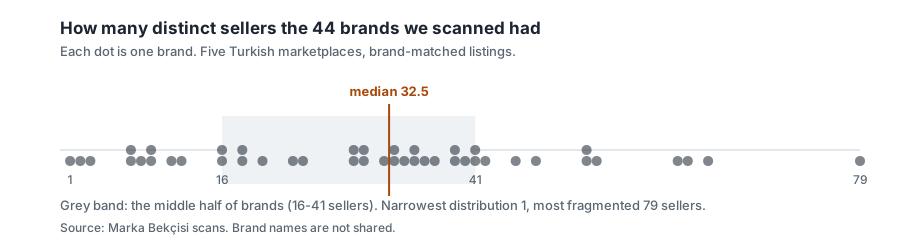
Across 44 brands we scanned on five Turkish marketplaces the median seller count was 32.5. Most of those sellers are not counterfeiters; the crowd a brand owner sees is usually grey market. A high seller count alone does not signal a counterfeit problem. It signals a distribution leak or an open parallel import flow. Brand owners often assume every unauthorised seller is a counterfeiter and file mass IP complaints. The data shows that strategy targets the wrong legal category in the majority of cases.
More on this: how unauthorised sellers appear on Trendyol.
Exhaustion of rights: what Article 152 actually says
Article 152 of Law No. 6769 provides that acts concerning goods put on the market by the right holder, or with the right holder's consent, fall outside the scope of the trademark right. Once a unit has been legitimately placed on the market, the right is exhausted as to that unit. This statutory language means the trademark owner cannot block further commercial movement of that specific unit. A brand owner monitoring Turkish marketplaces must understand that the law protects the free circulation of genuine goods after the first authorised sale. Filing a trademark complaint against a reseller of authentic products will not succeed on the basis of trademark rights alone.
In practice this means a seller who bought your product from you or from one of your dealers may resell it even without a contract with you. The absence of a contract is not, by itself, trademark infringement. Many brand owners assume that an "unauthorised seller" label justifies an intellectual property takedown request. That assumption is incorrect when the goods are genuine and were originally sold with consent. Marketplace compliance teams routinely reject such complaints because the legal right to control distribution ends at the first sale. The correct operational response is to review distribution agreements, not to file IP complaints.
The principle does not leave a brand owner without options. If the goods are not genuine, if the packaging has been altered, if batch or serial identifiers have been removed, or if the condition of the goods has changed after sale, the picture is different and those situations must be assessed separately. These factual variations can take the resale outside the exhaustion defence. A brand owner should document the specific condition of the product offered by the third-party seller. Evidence of repackaging, missing batch codes, or product degradation supports a complaint grounded in material difference rather than trademark infringement. Each variation requires its own evidentiary basis.
None of this is legal advice. Whether the right is exhausted in your specific case is a question for a trademark attorney or a lawyer; what this guide explains is why the complaint route so often produces nothing. Operational teams frequently waste resources filing takedowns that marketplaces are legally obliged to reject. Understanding the boundary between exhausted rights and actionable material difference prevents that waste. A qualified Turkish trademark attorney can evaluate the specific facts of your distribution chain and the listings you have flagged.
How many sellers does your brand have?
Shows where you sit in the seller distribution of the 44 brands we scanned across five Turkish marketplaces. The number you type never leaves your browser.
1median 32.579
| Fewest of the brands we scanned | 1 seller |
| Lower quartile (25%) | 16 sellers |
| Median | 32.5 sellers |
| Upper quartile (75%) | 41 seller |
| Most fragmented brand | 79 sellers |
This is not a measure of infringement. A high count can mean a wide and healthy distribution. The number only tells you how many separate parties sit on your product page and how many of them you recognise. If you cannot answer that, the problem is visibility, not the count.
More on this: the 48-hour takedown rule and its five mandatory elements.
Why the complaint route fails on genuine goods
Article 12 of the regulation requires the marketplace to remove a listing without delay and within no more than 48 hours on a compliant complaint. This deadline is absolute once the platform accepts the filing as complete. You must therefore ensure every mandatory field and attachment is present before you submit. A missing document resets the clock and gives the unauthorised seller more trading time. Many brand owners assume the 48-hour window starts when they hit send; it actually starts when the platform validates the complaint.
Article 13 then gives the seller a right of objection, supported by an invoice and supply chain documents tracing back to the right holder. The seller does not need to prove a contractual relationship with you, only a documentary chain that leads to the rights holder. A single invoice from a recognised distributor is often enough to satisfy this requirement. Brand owners frequently expect the marketplace to verify the commercial authenticity of that chain; the regulation does not impose that duty on the platform.
| Situation | Does an IP complaint work | What actually works |
|---|---|---|
| Goods are counterfeit | Yes — removal within 48 hours on a compliant complaint | Evidence plus a complete art. 12 filing |
| Genuine goods, seller holds documents | No — reinstated within 24 hours on objection | Distribution control and approved-supplier list |
| Genuine goods, seller cannot document | Indirectly — on Trendyol the listing closes after 36 hours | Registering your trademark in the seller panel |
| Packaging or condition altered | A separate situation to assess | Sample purchase, evidence, then a trademark attorney |
| Your product photo reused | Limited — not upheld where you hold the Buybox | Strengthening your own listing content |
Under Article 14 the listing is reinstated within 24 hours on a compliant objection, and the marketplace's review is limited to the documents submitted. The platform does not decide whether the goods are genuine. Its role is purely formal: are the documents present and do they appear to trace to the right holder? If the answer is yes, the listing returns automatically. Treating the marketplace as an adjudicator of product authenticity is a category error that leads to repeated frustration.
If the goods really are genuine, the seller can usually assemble that chain. Pressing the complaint route in that situation only costs time and burns the one complaint you had. You lose the immediate takedown, you lose the complaint credit, and the seller resumes trading within a day. The practical result is that the unauthorised listing stays live while you have exhausted the fastest enforcement tool. Redirecting that effort to authorised-dealer certificates or marketplace whitelists produces a durable barrier instead.
No second complaint on the same product and the same claim is processed unless new documents are supplied. Treating a grey-market listing as counterfeit therefore weakens your position when you later find a genuine counterfeit. You cannot simply refile with the same evidence after the seller's objection succeeds. The regulation treats the matter as closed until you bring materially new proof. Preserving your complaint capacity for actual counterfeits is a strategic necessity, not a procedural nicety.
| Provision | Key deadline | Practical implication for brand owners |
|---|---|---|
| Article 12 | Removal within 48 hours of a compliant complaint | Prepare every mandatory field and attachment before submitting; incomplete filings restart the clock. |
| Article 13 | Seller objection with invoice and supply-chain documents | The seller only needs a documentary chain to the right holder; the platform does not verify commercial authenticity. |
| Article 14 | Reinstatement within 24 hours of a compliant objection | The marketplace performs a formal document check only; it does not rule on whether goods are genuine. |
| Repeat complaints | Not processed without new documents | Filing against genuine grey-market goods consumes your single complaint credit and leaves you unable to act on real counterfeits later. |
More on this: how many sellers is normal for a brand in Turkey.
What works: distribution control
The remedy for grey market is distribution control rather than complaint. Three instruments matter: the authorised-dealer certificate, the marketplace's approved-supplier list, and the channel terms in your dealer agreements. Filing an intellectual property complaint against a seller of genuine goods fails because Turkish law recognises exhaustion of rights. A distribution framework lets you decide who may sell before a listing appears, instead of reacting after the fact. Brand owners who rely only on takedown requests find the same sellers reappear under new store names.
The authorised-dealer certificate is issued by the brand owner. A seller you certified can upload it and verify itself on the marketplace; a seller you did not certify cannot. This is the single point where the brand owner, not the platform, decides who is authorised. The certificate shifts the burden of proof onto the seller to demonstrate a documented supply chain. Without it, a marketplace has no basis to distinguish an approved distributor from a parallel importer. Many brand owners assume the platform maintains this list automatically, but the platform only enforces what you provide.
On Trendyol, once your trademark registration is approved, other sellers of that brand are asked to produce documents, and listings from sellers who cannot upload them close after 36 hours. Trendyol does not remove a listing merely because the seller is absent from your list, and a seller who documents its supply keeps selling. The 36-hour window is the platform's internal review period for the documents the seller submits. A seller with valid invoices from an authorised distributor therefore remains active even if you never added that seller to your approved list. Brand owners often mistake this for a platform error when it is the correct application of exhaustion rules.
That mechanism is exactly consistent with exhaustion of rights: the platform looks at who can document the supply, not at who has your permission. Turkish Intellectual Property Code article 152 allows resale of genuine goods once they have been put on the market with the rights holder's consent. The marketplace's role is to verify the paper trail, not to enforce your commercial preferences. If a parallel importer holds invoices tracing back to an authorised dealer in another EEA country, the platform must allow the listing. Attempting to block such a seller through an IP complaint exposes the brand owner to counter-notices and potential liability.
The panel path is Ürün > Belge ve Tescil İşlemleri > Marka Tescil İşlemleri, and the approved-supplier screen is called İzin Verdiğim Tedarikçiler, where sellers are added by store link rather than by seller ID. You must navigate to the brand registration section before the approved-supplier list becomes available. Entering a store link binds the authorisation to that specific storefront on Trendyol. Using a seller ID would not work because the same legal entity can operate multiple stores. Brand owners who try to paste a numeric ID into the field find the entry rejected.
Filling that list requires knowing who is selling first. Scanning five marketplaces by hand takes days; producing that list is exactly the work we do. You cannot authorise a seller you have not identified, and new unauthorised stores appear weekly. A one-time upload of your existing distributor network misses sellers who source through sub-distributors or cross-border channels. Continuous monitoring across Trendyol, Hepsiburada, Amazon.com.tr, n11 and Çiçeksepeti keeps the approved-supplier list current. Without that visibility, the distribution control framework has gaps that parallel importers exploit.
More on this: how to find every seller of your brand in Turkey.
The one thing you cannot do about price
The most visible symptom of grey market is a widening price distribution: the same product appears well below the median in one listing. That is a useful signal, not a lever. You can use the gap to identify where unauthorised stock is surfacing. You cannot use the gap to justify a price complaint to the marketplace. Treating the low price itself as the violation leads to rejected notices and wasted effort.
In Turkey, resale price maintenance — imposing a fixed or minimum resale price on independent sellers — is contrary to competition law, and a recommended price cannot be made binding. Any clause that tries to enforce a floor price on a distributor or retailer exposes you to competition-law risk. Marketplaces will not act on a notice that amounts to price enforcement. The law protects the seller’s freedom to set their own resale price once they hold genuine goods.
What is legitimate is reading the observed price distribution as a signal. Where the distribution opens up is usually where out-of-channel stock entered, and the real question is not the price but how the goods got there. You should map the listings that sit at the low end of the range. You should then ask which supply route fed those specific units. The price points you to the leak; it does not give you a legal handle on the seller.
Tracing that entry point means comparing batch and serial identifiers on a purchased sample against your own shipment records. That is the one solid way to close a channel without touching price. You buy the suspect listing, record the identifiers, and match them to the distributor or region that received that batch. When the match is clear, you address the source through your distribution controls. The marketplace has no role in that step.
What you may and may not put in your dealer agreements is a separate question governed by competition law; do not change contract wording without specialist advice. Territorial restrictions, selective distribution criteria, and online sales conditions all have limits under Turkish competition rules. A clause that works in another jurisdiction may be void here. You need a Turkish competition-law review before you amend any dealer terms.
If you would rather not count these by hand, we run the scan across all five marketplaces and send the report free: free scan.
Frequently asked questions
A seller with no contract is selling my brand in Turkey. Is that infringement?
Usually not on its own. If the goods are genuine and were placed on the market by the right holder or with the right holder's consent, Article 152 of Law No. 6769 means resale cannot be blocked on trademark grounds. The absence of a contract does not create infringement, which is why complaints against these listings tend to come back on objection.
How do I get a grey-market seller off a Turkish marketplace?
Through the document flow rather than the complaint flow. Once your trademark registration is recorded in the marketplace panel, other sellers are asked for an authorised-dealer certificate, and on Trendyol listings from sellers who cannot upload one close after 36 hours. A seller who can document its supply keeps selling, because the law permits it.
Are parallel imports and counterfeits the same thing?
No. In a parallel import the goods are genuine and arrived outside the brand owner's channel; in counterfeiting the goods are fake and carry the mark without permission. The complaint route works on counterfeits and usually does not work on parallel imports, and confusing the two also uses up your one complaint on that listing.
Can I make a grey-market seller respect my price?
No. Imposing a fixed or minimum resale price on independent sellers is contrary to Turkish competition law, and a recommended price cannot be made binding. You can only use the observed price distribution as a signal showing where out-of-channel stock entered the market.
How do I find where the out-of-channel stock came from?
Buy a sample from the listing and compare its batch and serial identifiers against your own shipment records. That shows which dealer the batch went to and lets you close the channel without touching price, which is the part competition law does not allow you to control.
Sources
- Industrial Property Law No. 6769 — full text (PDF, Turkish) — Article 152, exhaustion of rights: acts concerning goods put on the market by the right holder or with consent fall outside the scope of the right
- Regulation on Electronic Commerce Intermediary Service Providers and Electronic Commerce Service Providers — Official Gazette 29 December 2022, no. 32058 — complaint art. 12, objection art. 13, reinstatement art. 14
- Trendyol Seller Information Centre — Trademark Registration Process (Turkish) — After the trademark certificate is approved, other sellers are asked for documents; the 36-hour window
- Turkish Competition Authority — Guidelines on Vertical Agreements (PDF, Turkish) — Framework on resale price maintenance and distribution systems
- Turkish Patent and Trademark Office — Trademarks (Turkish) — Scope of trademark registration and ownership in Turkey
Related guides
How Many Sellers Is Normal on Turkish Marketplaces? A 44-Brand Benchmark (2026)
We scanned 44 brands across five Turkish marketplaces: median 32.5 sellers, middle half 16-41, most fragmented 79. Compare your own number.
21 September 2026 · 12 minThe Authorised Dealer Certificate in Turkey: What It Does and How to Issue It (2026)
The certificate the brand owner issues decides who stays on a Turkish marketplace. Why objections turn on it, the fields it must carry and how it fails.
6 September 2026 · 9 minWho Is Selling My Brand in Turkey? How to List Every Seller on Trendyol, Hepsiburada, Amazon.com.tr, n11 and Çiçeksepeti (2026)
A step-by-step method for finding every seller of your brand on the five Turkish marketplaces: where the seller identity is visible, how to pin a seller down with Trendyol's merchantId, what the buy box does to your product page, and why a one-off list goes stale in weeks.