Someone Is Selling My Brand on Trendyol: What a Foreign Brand Owner Can Actually Do (2026)
Muhammet Çay · 6 September 2026 · 10 min read
Short answer: First decide which of three situations you are in. If the listing is a genuine product that you or your distributor put on the market, Turkish law (Industrial Property Code No. 6769, art. 152, exhaustion of rights) does not let you block its resale on trademark grounds — the fix is distribution control, not a complaint. If the product is counterfeit or your trademark is being misused, the complaint route is open. On Trendyol the practical lever is the trademark registration flow: once your TÜRKPATENT registration is approved in the seller panel, other sellers of the same product are asked for a document; sellers who cannot upload one have their sales closed after 36 hours, and sellers who present a valid document keep selling.
Trendyol is the marketplace most international brands hear about first when they look at Turkey, and it is also where the first unpleasant surprise usually happens: a seller you have never heard of is on your product page, sometimes below your Turkish distributor's price, sometimes above it, sometimes with your own product photos.
Most English-language advice at this point is either generic ("file a takedown") or wrong ("Trendyol removes anyone who is not your dealer"). Neither matches what Trendyol's own seller documentation describes, and neither matches Turkish law. This guide sets out what the mechanism actually is, so that you choose the right tool for the situation you are in.
Three situations, three different answers
Before touching any form, separate the case in front of you into one of three buckets. The bucket decides everything that follows.
1. A genuine product that entered the market through you. Your distributor sold to a wholesaler, the wholesaler sold to a reseller, and the reseller opened a Trendyol store. Under article 152 of the Industrial Property Code No. 6769, once a product bearing your trademark has been put on the market by you or with your consent, you cannot rely on the trademark to prevent its further sale. This is the exhaustion of rights principle. A complaint that says "this seller is not my authorized dealer" describes a distribution problem, not a trademark infringement, and the marketplace's own mechanism is built to reflect that.
2. A genuine product from outside your supply chain. Grey-market stock, stock bought abroad, stock from a discontinued dealer. Legally this is close to the first bucket; commercially it is the one that hurts most because it undercuts your Turkish pricing structure. The tools here are contractual and operational: authorized-seller documents, the marketplace's pre-authorization lists, and knowing who is selling before your distributor tells you.
3. Counterfeit goods, or your trademark used without any product of yours behind it. Your brand name in another seller's listing title, your logo on packaging you never produced, your official photos on a product that is not yours. This is the bucket the complaint procedure exists for.
Everything below is sorted by these buckets. If you skip this step, you will spend your ten notice links per month on the wrong cases and lose the leverage you need for the right ones.
Find out who the seller is
Trendyol listing URLs carry a merchantId parameter; the seller's store page
has its own link. Record both. Store display names change, and a seller who
receives a notice may rename the store; the merchant identifier and store link
stay constant.
Seller pages on Trendyol show the seller information the platform requires of Turkish businesses: trade name, and registration details. Turkey's electronic commerce information system (ETBİS) lets you check whether a registered e-commerce business exists behind that name. You do not need any account for either step.
When you monitor a brand across five marketplaces, this identification step is what turns a list of listings into a list of sellers. Our reports are grouped by seller for this reason: one seller with forty listings is one conversation, not forty.
What Trendyol's trademark mechanism really does
This is the part most often described incorrectly, including in Turkish sources. Trendyol does not maintain a "brand protection program" in which listing a dealer whitelist causes everyone else to be removed. The seller documentation describes a document-based process:
- In the seller panel you go to Ürün > Belge ve Tescil İşlemleri > Marka Tescil İşlemleri (Product > Document and Registration Transactions > Trademark Registration Transactions) and upload your trademark registration.
- Once the registration is approved, other sellers offering the same products are asked to provide a document showing their entitlement to sell the brand.
- Sellers who cannot upload a document have those products closed to sale after 36 hours.
- Sellers who present an accepted document continue selling.
Read step 4 twice. A reseller who can show a valid document — an authorized seller certificate, or supply-chain paperwork leading back to you — stays on the product page. That is exactly the exhaustion-of-rights rule in article 152 applied by the platform. The mechanism removes sellers who cannot show a source; it does not remove sellers because you would prefer they were not there.
Two practical consequences:
- The registration must be one that is in force in Turkey. A TÜRKPATENT registration, or an international registration that designates Turkey. A registration in your home country alone is not what the panel asks for.
- The 36 hours is Trendyol's internal service level, both for closing undocumented sellers and for reviewing notices. It is not the same as the 48-hour rule in the Turkish e-commerce regulation, which is a legal deadline for processing a formal complaint. The two run separately; see Turkey's 48-hour takedown rule.
Suppliers I Authorize
The panel screen is literally called İzin Verdiğim Tedarikçiler — "Suppliers I Authorize". You add sellers to it by their store link, not by merchant identifier. Sellers on the list are treated as sellers with an approved document for your brand.
Keep this list current. The failure mode we see most often is a brand that uploaded its registration two years ago, never added the new distributor, and now has its own dealer receiving document requests. The list is also your reference for the dealer-list matching we run in monitoring: sellers on the list are expected; sellers not on it are candidates for review — not infringements, candidates.
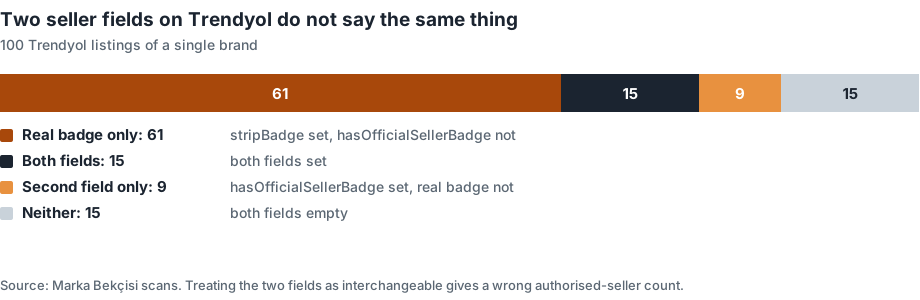
The Authorized Seller badge is tied to a document, not to you
Trendyol shows a Yetkili Satıcı (Authorized Seller) badge on some sellers. The badge is granted when the seller uploads an authorized-seller document and Trendyol approves it. Documents are rejected when they have expired, lack a signature or stamp, or were not issued by the brand owner.
So the absence of the badge tells you one of three things: the seller never uploaded a document, the document was rejected, or your brand never set up the flow at all. None of the three is evidence of infringement. We say this in every report because brands routinely treat a badge-less seller as a target, file a notice, and then find the seller was buying from their own distributor.
A seller whose badge is approved is also exempt from Trendyol's authenticity checks for that brand and category — a real operational benefit you can offer your legitimate dealers.
Buy box and pricing
Trendyol's documentation lists the condition for being eligible for the buy box on a product: the product must have been sourced from the trademark owner registered at TÜRKPATENT or from an authorized seller. The buy box ranking itself weighs price, seller rating, fast delivery, free shipping, campaign discount depth and the seller's operational status (a red status is excluded from ranking; orange goes to the bottom).
Two warnings for foreign brands used to other jurisdictions:
- Resale price maintenance is prohibited under Turkish competition law. You cannot instruct your dealers what price to charge on Trendyol. What you can do is observe the price spread and act on the supply side. Our reports describe prices as an observed distribution for this reason.
- If you are yourself in the buy box on a listing and you file an image infringement notice against another seller on that same listing, Trendyol marks it "Uygun Değil" (not eligible). "They are using my photo" is not a lever on its own.
Infringement notices: limits and the five-rejection rule
For bucket 3 cases — counterfeits and trademark misuse — the panel offers İhlal Bildirimleri (Infringement Notices) and, for a brand owner who wants other sellers of its own registered product to be closed, Satıcı Bazlı Marka İhlal Bildirimi (Seller-Based Trademark Infringement Notice).
The limits matter for planning:
- 10 links per notice for trademark cases, 5 links for image and design cases.
- Review within 36 hours.
- If your supporting document is rejected five times, you wait one month before filing again for that brand.
The one-month lockout is why we never recommend bulk-filing every suspicious listing. A notice built on a weak document costs you a month of access to the tool. Prepare the file first, file the strong cases, keep the evidence for the rest.
The limits that apply to a notice are worth keeping in one place:
| Rule | Value | Applies to |
|---|---|---|
| Links per notice, trade mark | 10 | Seller-based trade mark infringement notice |
| Links per notice, image or design | 5 | Image and design notices |
| Review time | 36 hours | Trendyol's own service level |
| Document window after registration | 36 hours | Sellers who cannot supply a certificate |
| Rejections before a lock-out | 5 | One month wait for the same brand |
None of these is the 48-hour figure from the Regulation. The 48 hours is the statutory removal deadline on a valid complaint; every number above is Trendyol's own operating rule. Mixing the two is the most common mistake in this process.
If you have no Trendyol seller account
All of the panel screens above require a seller account on Trendyol. A brand that only distributes through third parties has two options.
The first is to run the panel through your Turkish distributor's account, with a
written agreement about who files what. The second is the formal channel that
the Turkish e-commerce regulation opens to any rights holder regardless of
platform accounts: a notarized notice, or a message from a registered
electronic mail (KEP) address. Trendyol's operating company publishes the KEP
address dsm@hs02.kep.tr. The regulation treats the internal system, notary
and KEP as equivalent channels, and the same 48-hour processing rule applies
to each. The full channel list for all five marketplaces is in
Turkish marketplace IP contacts and KEP addresses.
A notice by notary or KEP has to contain the five elements the regulation requires — including a declaration of responsibility for the accuracy of the complaint. That declaration is the reason we produce evidence files but do not file notices on a client's behalf.
What monitoring adds
The panel tells you about sellers after you have found them. It does not tell you that a new seller appeared on Tuesday, that a known seller dropped its price by 30% on Thursday, or that your product photos are now on a listing in another category. Weekly monitoring across Trendyol, Hepsiburada, Amazon.com.tr, n11 and Çiçeksepeti does, and it sorts each finding into the three buckets above before you spend a notice link on it.
We run a free initial scan for any brand: every listing under your brand name on the five marketplaces, grouped by seller, with the observed price range and badge status. Pricing for ongoing monitoring is on the English landing page.
Frequently asked questions
Can I make Trendyol remove a seller who is not my authorized dealer?
Not on that ground alone. Trendyol's mechanism asks other sellers for a document once your registration is approved; a seller who presents a valid document keeps selling. Under article 152 of Code No. 6769, a genuine product placed on the market with your consent can be resold. The tool for unwanted but legitimate resellers is distribution control, not a takedown.
What happens 36 hours after my trademark registration is approved?
Sellers of the same products who could not upload a document have those products closed to sale. Sellers who uploaded an accepted document continue. The 36 hours is Trendyol's internal timing and is separate from the 48-hour legal deadline for formal complaints.
Does a missing Authorized Seller badge mean the seller is illegitimate?
No. The badge depends on a document the seller uploads and Trendyol approves. No badge can mean no upload, a rejected upload, or a brand that never set the flow up. Treat a badge-less seller as a candidate for review.
Do I need a Turkish trademark registration?
The panel flow is built around a registration in force in Turkey — a TÜRKPATENT registration or an international registration designating Turkey. For the legal complaint route, the regulation's first mandatory element is the registration certificate, so the same applies.
How many listings can I report at once?
Ten links per notice for trademark cases and five for image or design cases, with review within 36 hours. Five rejected documents for the same brand lead to a one-month waiting period.
Can I file without a Trendyol seller account?
Yes, through the channels the regulation guarantees: a notarized notice or a
message from a KEP address to dsm@hs02.kep.tr. The notice must contain the
five mandatory elements, including the declaration of responsibility.
Can I tell my dealers what price to set on Trendyol?
No. Resale price maintenance is prohibited under Turkish competition law. You can observe the price distribution and act on supply and contracts, not on the price itself.
Trendyol rejected my image infringement notice. Why?
One documented reason: if you are in the buy box on the listing you reported, Trendyol treats an image notice on that listing as not eligible. Photo reuse alone is not a lever; a trademark or counterfeit case is.
Sources
- Trendyol Academy — Seller Information Center (Turkish) — Trademark registration flow, Suppliers I Authorize, Authorized Seller badge, infringement notice limits, the 36-hour rule and the five-rejection rule. The site is a single-page app; open it in a real browser
- Industrial Property Code No. 6769 (Turkish) — Exhaustion of rights, article 152
- Turkish Patent and Trademark Office (TÜRKPATENT) — Trademark registration and search
- Regulation on Electronic Commerce Intermediary Service Providers and Electronic Commerce Service Providers (Turkish) — Official Gazette 29 December 2022, no. 32058 — complaint (art. 12), objection (art. 13), outcome (art. 14)
Related guides
Hepsiburada IP Complaints for Brand Owners: Notary or KEP Only, 48 Hours Down, 24 Hours Back (2026)
How a rights holder files an intellectual-property complaint on Hepsiburada: why the seller portal is closed to brand owners, the KEP address dmarket@hs02.kep.tr, the mandatory elements, the sample declaration templates, the 48-hour removal, the 24-hour republication, and the one-shot rule.
22 September 2026 · 11 minTrendyol's Approved Suppliers List: How Brand Owners Control Distribution (2026)
Trendyol does not delete listings from sellers off your list. It asks them for documents, and those who cannot produce them close after 36 hours.
21 September 2026 · 12 minThe Authorised Dealer Certificate in Turkey: What It Does and How to Issue It (2026)
The certificate the brand owner issues decides who stays on a Turkish marketplace. Why objections turn on it, the fields it must carry and how it fails.