Hepsiburada IP Complaints for Brand Owners: Notary or KEP Only, 48 Hours Down, 24 Hours Back (2026)
Muhammet Çay · 6 September 2026 · 9 min read
Short answer: On Hepsiburada, a rights holder files an intellectual-property complaint by notary or by registered electronic mail (KEP) — the internal messaging system inside the seller portal is open to sellers with a store on the platform, not to brand owners. The KEP address Hepsiburada publishes for these applications is dmarket@hs02.kep.tr. A complete complaint must contain the five elements the Turkish e-commerce regulation requires; Hepsiburada publishes sample declaration-of-responsibility templates for the complaint and for the seller's objection. A complete complaint leads to removal within 48 hours; a proper objection with invoice and supply-chain documents brings the listing back within 24 hours, and no second complaint on the same product and claim is processed without new documents.
Hepsiburada is the second marketplace most foreign brands meet in Turkey, and the one where the seller picture is easiest to see. It is also the marketplace where brand owners most often send their complaint to the wrong place and wait for weeks. This guide follows Hepsiburada's own published application process and the Turkish regulation behind it: the channel, the content, the clocks, and the rule that makes each complaint a single attempt.
The advantage first: the seller name is visible
From a brand owner's point of view, Hepsiburada's most valuable feature is this: the search results print the seller's store name directly.
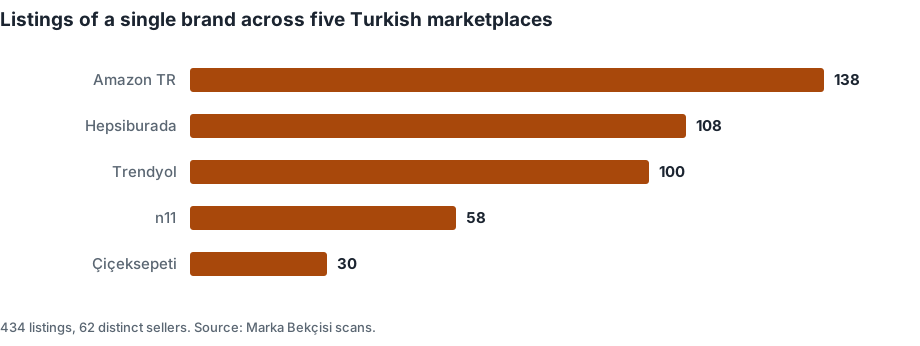
On Trendyol you must open a product page to learn who the seller is; the search result carries only a numerical seller identifier. On Hepsiburada the store name is on the listing card. If several sellers share one product page, the "other sellers" list on that page gives the full breakdown. Combining the two, one brand's seller map on Hepsiburada can be built in half a day. The method for all five marketplaces is in who is selling my brand in Turkey.
The channel: notary or KEP for rights holders
This is the point most often misunderstood. Hepsiburada's published process separates two parties:
| Who | Channels available |
|---|---|
| Rights holder (brand owner, its attorney) | Notary or KEP |
| Seller (a third party with a store on the platform) | Notary, KEP or the internal communication system (Seller Portal) |
The internal communication system — the messaging channel inside the seller panel — is open to sellers for complaint applications. If your brand does not have a store on Hepsiburada, do not expect to file an infringement report from a panel; the route defined for you is notary or KEP.
The KEP address Hepsiburada announces for these applications:
dmarket@hs02.kep.tr
The distinction delays real files by weeks. The brand owner e-mails seller support, receives "forwarded to the relevant department", and the process vanishes. Under the regulation, the clock starts only when a complete complaint reaches the platform through one of the recognized channels. Why the channel matters this much is in Turkey's 48-hour takedown rule.
Choosing between notary and KEP:
- KEP (registered electronic mail) is fast and produces a delivery record; it is the practical route for corporate brands. You need a KEP account of your own, or a Turkish attorney or distributor who has one.
- Notary is slower and costlier, but a notarized notice lays a direct foundation for later legal steps.
The gain is the same in both: you can prove when the complaint arrived. In files that turn into a dispute about deadlines, that record decides.
Mandatory elements of the complaint
Hepsiburada's list matches article 12 of the regulation one to one. If any element is missing, the complaint is not taken into consideration; only a deficiency notice is sent.
| Element | What it means in your Hepsiburada file |
|---|---|
| Proof of the right | TÜRKPATENT registration certificate (PDF). For copyright, the relevant certificate or collecting-society document |
| Identity and contact details | Natural person: name, national identity number, address, e-mail, KEP if any. Legal entity: trade name, address, e-mail, KEP if any |
| Power of attorney (if any) | The same details for principal and attorney, plus the document showing authority to act |
| Grounds and evidence | Why the listing infringes, with screenshots, dates, comparison |
| Internet address of the product | The full URL of the listing complained of |
| Declaration of responsibility | A declaration of liability for damage arising if the information and documents are untrue |
For the last row, Hepsiburada publishes downloadable sample declaration templates on its application page — one for the complaint, one for the seller's objection. Using the template is faster than drafting your own and arguing about form.
Do not take the declaration lightly. It is not a formality: the applicant can be held liable for damage caused by a wrongly removed product. The risk of sending bulk, unchecked complaints sits exactly here. This is why our reports call findings candidates for review, not infringements — a finding should not become a complaint without human assessment.
The complaint file
Beyond the mandatory elements, some attachments speed up the review and protect you in later steps:
| Document | Why |
|---|---|
| Trademark registration certificate | Proof of the right |
| List of classes covered by the registration | To show overlap with the listing's category |
| Full URL of the listing | So that review is possible |
| Screenshot of the listing with date | So that evidence survives removal |
| Nature of the infringement | Counterfeit, unauthorized logo use, brand name on another product — each needs different evidence |
| Seller name and store link | So that the seller's other listings can be assessed |
| Power of attorney | If filing through an attorney |
The screenshot row is neglected and critical: once the listing is removed the link dies and you have no record that the infringement existed. When the seller objects, you have nothing to compare against.
48 hours down, 24 hours back
The two clocks are not Hepsiburada's commercial choice; they come from articles 12 and 14 of the e-commerce regulation and apply to every marketplace. Hepsiburada's difference is that it states the rule in writing on its own application page.
- Removal: on a complete complaint, the product is removed from publication without delay and within 48 hours at most of receipt; both the rights holder and the seller are informed.
- Republication: if the seller's proper objection shows from the submitted documents that the seller is in the right, the product is republished within 24 hours at most of receipt of the objection.
The second clock exposes a fact most brand owners do not plan for: a complaint is not a one-way, final action. A product can come down and come back the next day.
The scope of the objection review is also limited: it is confined to the information and documents submitted by the seller (regulation art. 14/3; Hepsiburada repeats this on its page). Do not send an incomplete file on the assumption that you will be asked for more at the objection stage. The stronger your first application, the better it holds when compared with the seller's documents.
The threshold for a second complaint: "new documents"
The most critical and least known rule: unless new documents proving the infringement are submitted, complaints about the same product and the same claim are not processed. The rule comes from article 14/2 of the regulation; it is not a Hepsiburada peculiarity and applies on every marketplace.
The practical consequence is heavy. If a weak first complaint is rejected or falls to the seller's objection, trying again for the same listing is not free; you need new evidence. So the order must be:
- Build the complete file — five elements, dated screenshots.
- Make the claim precise — "counterfeit" and "unauthorized logo use" call for different evidence.
- Then file.
"Let's try, and if it fails we'll file again" does not work on any Turkish marketplace. In practice your file is a single shot.
Review and outcome
Common reasons a complaint is rejected:
- one of the mandatory elements is missing — the complaint was never processed;
- the registration's scope does not match the listing's category;
- the infringement claim is not made concrete;
- the seller has documented lawful sourcing.
The last matters most: selling a branded product is not an infringement by itself. If the seller can present an invoice showing the product is genuine and supply-chain documents reaching back to the rights holder, the listing returns. This points the same way as the exhaustion-of-rights rule in article 152 of the Industrial Property Code No. 6769: a product placed on the market with the trademark owner's consent cannot be blocked from resale on trademark grounds.
So "not my dealer" cannot on its own found a complaint. A brand that wants authorization-based control needs distribution contracts, written authorized-seller documents and the marketplaces' own authorized-seller mechanisms — not notices.
Three questions before you file
- Is the product counterfeit, or genuine but sold outside your channel? The first is a complaint; the second is a distribution problem.
- Does your registration cover the listing's category? Class mismatch is a standard rejection ground.
- Do you have evidence that survives the listing's removal? Dated screenshots, the store link, the observed price.
What sets Hepsiburada apart
Because the search result shows the seller name, detection on Hepsiburada is markedly easier than on Trendyol. On the protection side, however, it works listing by listing: there is no equivalent of Trendyol's "Suppliers I Authorize" list that triggers a bulk document request from sellers not on it. Every case is filed separately, and regular monitoring is what keeps the picture current.
The balance: on Hepsiburada it is easy to see and hard to block. Since detection is cheap, the real difference lies in collecting findings regularly and sorting out which ones are genuinely worth a file.
We scan the five Turkish marketplaces weekly and merge them into one table; the listing URL, seller name and date a complaint needs come straight out of that report, in English. Start with a free initial scan; the packages are on the English landing page.
Frequently asked questions
Where do I file an IP complaint on Hepsiburada as a brand owner?
By notary or by KEP (registered electronic mail) to dmarket@hs02.kep.tr.
The internal messaging system in the seller portal is open to sellers with a
store on the platform, not to rights holders.
How fast does Hepsiburada act on a complaint?
On a complete complaint, removal without delay and within 48 hours at most, with notice to both the rights holder and the seller.
The listing was removed but came back. How?
The seller objected with an invoice and supply-chain documents reaching back to the rights holder. On a proper objection the listing is republished within 24 hours. The review is limited to the documents submitted.
Can I complain again about the same listing?
Not on the same product and the same claim unless you submit new documents proving the infringement.
Do I have to be a Hepsiburada seller to complain?
No. The rights-holder route is notary or KEP, independent of any store on the platform.
What should I ask of my own dealers on Hepsiburada?
A written authorized-seller document from you and invoices that trace the supply chain back to you. That paperwork is what lets a legitimate reseller answer an objection — and what lets you tell them apart from everyone else.
The listing was not removed after my complaint. What can I do?
First check that all five elements were present — an incomplete complaint is not processed and the clock never started. If the file was complete and sent through a recognized channel with a delivery record, the matter is one for your Turkish trademark attorney.
One seller has dozens of listings. Do I file each separately?
The complaint is made per listing URL, but one application can list several URLs. Include the seller's store link so that the seller's other listings can be assessed together.
The listing was removed, but the seller opened a new one. Now what?
A new listing is a new URL and a new complaint — with the same documents plus the new address. This is the case that only weekly monitoring with an archive catches.
Sources
- Hepsiburada — Application Process for Intellectual and Industrial Property Rights Infringement (Turkish) — Notary or KEP for rights holders; the KEP address; sample declaration templates; 48-hour removal, 24-hour republication, no second complaint without new documents. Returns 403 to scripts — opens in a normal browser
- Regulation on Electronic Commerce Intermediary Service Providers and Electronic Commerce Service Providers (Turkish) — Official Gazette 29 December 2022, no. 32058 — complaint (art. 12), objection (art. 13), outcome (art. 14)
- Law No. 6563 on the Regulation of Electronic Commerce (Turkish) — Obligations of intermediary service providers, article 9
- Turkish Patent and Trademark Office (TÜRKPATENT) — Registration certificate and trademark search
- Industrial Property Code No. 6769 (Turkish) — Exhaustion of rights, article 152
Related guides
Çiçeksepeti Brand Complaints: What to Do When There Is No Portal (2026)
Çiçeksepeti has no public brand-owner portal. The notary and KEP route produces the same legal effect: the channel, the address and the required elements.
9 September 2026 · 12 minn11 Brand Protection Centre: Membership and Filing an Infringement Notice (2026)
n11 does not accept direct IP complaints. You join the Brand Protection Centre first: the documents, the address, the KEP alternative and the filing flow.
6 September 2026 · 5 minWhere to Send an IP Complaint on Turkish Marketplaces: Channels and KEP Addresses (2026)
The rights-holder channel and verified KEP address for each of the five Turkish marketplaces: Trendyol, Hepsiburada, n11, Çiçeksepeti and Amazon.