Turkey's 48-Hour Marketplace Takedown Rule: How IP Complaints Work on Turkish Platforms (2026)
Muhammet Çay · 6 September 2026 · 8 min read
Short answer: Under the Turkish Regulation on Electronic Commerce Intermediary Service Providers (Official Gazette 29 December 2022, no. 32058), a marketplace must remove a listing without delay and within 48 hours at most once it receives a complete intellectual-property complaint through its internal system, a notary or registered electronic mail (KEP). Complete means five elements: the registration certificate, the complainant's identity and address, the grounds and evidence, the listing's internet address, and a declaration of responsibility for the accuracy of the complaint. An incomplete complaint is not processed, so the 48 hours never start. The seller may object with an invoice and supply-chain documents reaching back to the rights holder; on a proper objection the listing is republished within 24 hours, and no second complaint on the same product and claim is processed without new documents.
If you sell into Turkey from abroad, the most useful single fact about Turkish marketplace enforcement is that it is written down in one regulation and applies to every marketplace. Trendyol, Hepsiburada, n11, Çiçeksepeti and Amazon.com.tr each have their own portals, forms and habits, but the deadline, the content of a valid complaint and the seller's right to object come from the same text. Once you know the text, the platforms become variations on a theme rather than five separate legal systems.
This guide is that text, in operational English. It is not legal advice; it is what the regulation says and what the marketplaces do with it.
The 48-hour rule is real
The Regulation on Electronic Commerce Intermediary Service Providers and Electronic Commerce Service Providers was published in the Official Gazette on 29 December 2022 (no. 32058). Its article 12 deals with complaints about listings that infringe intellectual and industrial property rights.
On receipt of a complaint that meets the regulation's requirements, the intermediary service provider — the marketplace — must remove the product from publication without delay and in any event within 48 hours, and notify both the seller and the rights holder. "Without delay" is the operative standard; 48 hours is the ceiling, not the target.
The underlying statute is Law No. 6563 on the Regulation of Electronic Commerce, whose article 9 sets out the intermediary's obligations; the regulation is the detailed procedure under it.
An incomplete complaint never starts the clock
The same article 12 says that a complaint which does not contain the required elements is not processed. This is the sentence that explains most of the "we filed weeks ago and nothing happened" stories.
A marketplace that receives a complaint missing, say, the declaration of responsibility is not late when it does nothing. The 48 hours have not begun. Some platforms reply asking for the missing item; some simply leave the ticket open. Either way, the delay is on the complainant's side, and the fix is to send a complete complaint, not to escalate.
Where the complaint goes
Article 12 names three channels and treats them as alternatives:
- The marketplace's internal communication system — its seller panel or rights-holder portal, where one exists.
- A notary notification.
- A message from a registered electronic mail address, known in Turkey as KEP (Kayıtlı Elektronik Posta).
Two consequences for foreign brand owners. First, a marketplace that offers no portal to rights holders has not escaped the rule; notary and KEP carry the same obligation and the same deadline. Çiçeksepeti publishes no rights-holder portal, and Hepsiburada states that a rights holder may use only notary or KEP — its internal system is for sellers with a store on the platform. Second, you will need either a KEP address, a notary, or someone in Turkey who has one of them. A Turkish trademark attorney or your distributor typically fills this role. The addresses for each marketplace are in Turkish marketplace IP contacts and KEP addresses.
The five elements the regulation requires
A complete complaint contains:
| # | Element | What it means in practice |
|---|---|---|
| 1 | Registration certificate for the right | Your trademark, design or patent registration in force in Turkey — a TÜRKPATENT certificate or an international registration designating Turkey. A home-country registration alone does not meet this element. |
| 2 | Identity and address of the complainant | The rights holder's legal identity and address. If an attorney or distributor files, the authority to act should be in the file. |
| 3 | Grounds and evidence | Why the listing infringes, with the material that shows it: photographs, comparison with the genuine article, test-purchase results, the registered mark alongside the listing. |
| 4 | The internet address of the listing | The exact URL. Marketplaces act on listings, not on sellers or product names. One complaint can list several URLs; each must be identified. |
| 5 | Declaration of responsibility | A statement that the complainant is responsible for the accuracy of the information and the consequences of the complaint. |
The table is short, but element 5 is where the weight sits.
The declaration of responsibility is not a formality
The marketplace does not decide whether your trademark is actually infringed. Article 14 limits the platform's review to the documents submitted. In exchange for acting quickly and without investigating the merits, the regulation shifts the risk of a wrong complaint onto the complainant through the declaration.
The practical reading: a complaint that removes a legitimate seller's listing on a claim that turns out to be wrong is a complaint you have signed for. This is why we describe our monitoring findings as candidates for review rather than infringements, why the evidence file we prepare leaves the rights-holder fields blank for the client to complete, and why we do not file notices on a client's behalf.
The seller's objection and the 24-hour return
Article 13 gives the seller whose listing was removed the right to object through the same channels. The objection must include:
- the invoice for the product, and
- supply-chain documents reaching back to the rights holder — the paper trail from the seller's supplier up to you or your licensee, and
- the seller's own declaration of responsibility.
Article 14 then sets the outcome. On an objection that meets these requirements, the marketplace republishes the listing within 24 hours. After that, no second complaint about the same product and the same claim is processed unless new documents are submitted. The platform's review at every stage is limited to documents; it does not weigh arguments.
Put together, articles 12 to 14 describe a single exchange: you file with documents; the seller answers with documents; the platform compares the two piles once. A seller who bought genuine goods from your distributor can produce an invoice chain that leads to you, and the listing comes back. That is consistent with the exhaustion-of-rights rule in article 152 of the Industrial Property Code: a genuine product placed on the market with your consent can be resold. The complaint route is for counterfeits and trademark misuse, not for resellers you would rather not have.
One shot per listing
The "no second complaint without new documents" rule turns each complaint into a single attempt. A weak first complaint against a listing that is then republished blocks you from a stronger complaint later — unless you can show something new.
The operational consequence is the opposite of the instinct most brands have when they first see the scale of the problem. Filing everything at once produces a wave of removals, a wave of objections, a wave of republications, and then a locked position on every listing where the seller had paperwork. Filing the cases you have evidence for, and monitoring the rest, keeps your options open.
Evidence before the complaint
Once the marketplace removes a listing, the page is gone, and with it the seller name, the price, the photos and the title that made your case. Collect before you file:
- a timestamped screenshot of the listing and of the seller's store page;
- the listing URL and the seller identifier (on Trendyol, the
merchantIdparameter; on Hepsiburada and n11, the store slug; on Amazon, the seller parameter); - the observed price and, if you monitor over time, the first-seen and last-seen dates;
- for counterfeit claims, the test purchase record and the comparison with the genuine article.
Our evidence files are built around this list, section by section in the order of the five elements, so that the client's attorney can complete the identity and declaration sections and file.
What changes by marketplace and what does not
The regulation does not change. What changes is the door:
- Trendyol offers an internal notice system in its seller panel with its own 36-hour review period and link limits (10 for trademark, 5 for image and design). The 36 hours is Trendyol's service level; the 48 hours is the legal ceiling. They are different clocks. Details in unauthorized sellers on Trendyol.
- Hepsiburada publishes a page describing the process and states that rights holders must use notary or KEP; it also publishes sample declaration texts for complaints and objections.
- n11 runs a separate Brand Protection Center with its own membership requirements.
- Çiçeksepeti has no public rights-holder portal, so notary or KEP is the route.
- Amazon.com.tr has Brand Registry with its own notice tool; the Turkish regulation applies to Amazon.com.tr as an intermediary all the same. See Amazon Turkey Brand Registry after approval.
Monitoring makes the complaint complete
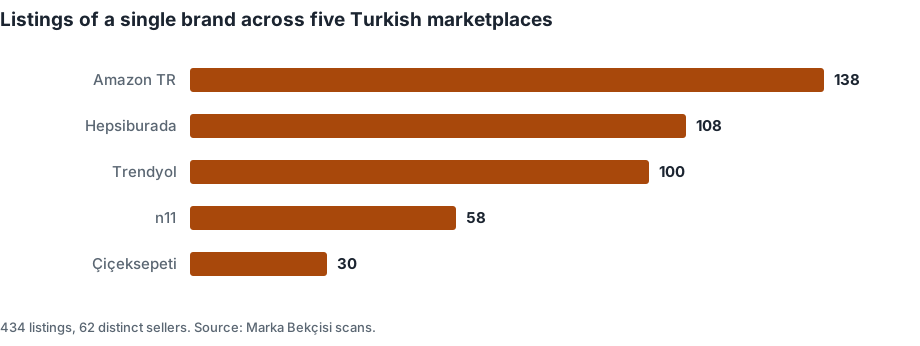
Element 4 asks for the internet address of the listing; element 3 asks for evidence; the objection rule asks you to know whether the seller has a paper trail before you file. None of that comes from the complaint form. It comes from knowing, every week, which sellers offer your brand on the five marketplaces, at what price, since when, and whether they are on your dealer list.
We run a free initial scan that produces exactly that picture for one brand. For ongoing coverage, the packages are on the English landing page.
Frequently asked questions
How long does a Turkish marketplace have to act on an IP complaint?
Without delay and within 48 hours at most, counting from receipt of a complaint that contains all five required elements (article 12 of the regulation published in Official Gazette no. 32058).
Why was my complaint not processed?
Most often because one of the five elements was missing — typically the declaration of responsibility or a registration in force in Turkey. The regulation says an incomplete complaint is not processed, and the 48-hour period does not start.
The marketplace has no portal for brand owners. What do I do?
Use a notary notification or a message from a KEP (registered electronic mail) address. Article 12 treats the internal system, notary and KEP as equivalent channels with the same deadline.
Can the seller get the listing back?
Yes. An objection with the invoice, supply-chain documents reaching back to the rights holder and the seller's declaration leads to republication within 24 hours under article 14.
Can I complain again after the listing is republished?
Not on the same product and the same claim unless you submit new documents. The marketplace's review is limited to the documents submitted.
Is Trendyol's 36 hours the same as the regulation's 48 hours?
No. The 36 hours is Trendyol's internal review and closing period. The 48 hours is the legal ceiling for processing a complete complaint on any marketplace.
Do I need a Turkish trademark registration to complain?
The first mandatory element is the registration certificate for the right. In practice that means a registration in force in Turkey — a TÜRKPATENT registration or an international registration designating Turkey.
What happens if my complaint turns out to be wrong?
The declaration of responsibility places the consequences of an inaccurate complaint on the complainant. The platform does not examine the merits; you have signed for the accuracy. Discuss the specific exposure with a Turkish trademark attorney before filing.
Sources
- Regulation on Electronic Commerce Intermediary Service Providers and Electronic Commerce Service Providers (Turkish) — Official Gazette 29 December 2022, no. 32058 — complaint (art. 12), objection (art. 13), outcome (art. 14)
- Law No. 6563 on the Regulation of Electronic Commerce (Turkish) — Obligations of intermediary service providers, article 9
- Hepsiburada — Application Process for Intellectual and Industrial Property Rights Infringement (Turkish) — The platform's published process: notary or KEP for rights holders, its KEP address, the 48-hour removal, the 24-hour republication, and the no-second-complaint rule. Returns 403 to scripts; opens in a normal browser
- Trendyol Academy — Seller Information Center (Turkish) — Trendyol's separate internal 36-hour review and closing period, notice link limits
- Industrial Property Code No. 6769 (Turkish) — Exhaustion of rights, article 152
Related guides
Where to Send an IP Complaint on Turkish Marketplaces: Channels and KEP Addresses (2026)
The rights-holder channel and verified KEP address for each of the five Turkish marketplaces: Trendyol, Hepsiburada, n11, Çiçeksepeti and Amazon.
6 September 2026 · 9 minHepsiburada IP Complaints for Brand Owners: Notary or KEP Only, 48 Hours Down, 24 Hours Back (2026)
How a rights holder files an intellectual-property complaint on Hepsiburada: why the seller portal is closed to brand owners, the KEP address dmarket@hs02.kep.tr, the mandatory elements, the sample declaration templates, the 48-hour removal, the 24-hour republication, and the one-shot rule.
24 September 2026 · 14 minWhat Turkish Marketplaces Will Not Do for Your Brand (2026)
Platforms do not decide whether goods are counterfeit. What the regulation actually obliges them to do, and which four expectations fail every time.