What Turkish Marketplaces Will Not Do for Your Brand (2026)
Muhammet Çay · 24 September 2026 · 14 min read
Short answer: Turkish marketplaces are obliged to act on a compliant complaint, not to judge your case. Under the e-commerce regulation a marketplace must remove a listing without delay and within no more than 48 hours once a complaint carrying all five mandatory elements arrives, must reinstate it within 24 hours on a compliant objection, and must limit its review to the documents submitted. It does not decide whether the goods are genuine, it does not enforce your distribution agreement, it does not police your prices, and it does not tell you which sellers are out there. Every one of those is left to the rights holder, and the platform's design deliberately places the risk on whichever party signs the declaration of liability.
What the regulation actually obliges
Under Article 12 of the Turkish e-commerce regulation, a marketplace must remove a listing without delay and within no more than 48 hours once it receives a complaint carrying all five mandatory elements. The clock starts only when the filing is complete; an incomplete submission does not trigger the period at all. In practice, this means you must assemble every required document before you hit send, because a missing attachment resets the timeline to zero. Many brand owners assume the 48-hour window begins when they first contact support, but the regulation ties the deadline to a formally complete notice. If you file on a Friday afternoon and the platform spots a missing element on Monday, the 48 hours only start from Monday.
The five elements are the trademark registration certificate, the identity and address of the rights holder, the grounds and evidence, the internet address of the product, and a declaration accepting liability if the claim proves untrue. An incomplete filing is not processed, and the period does not start. Each element serves a distinct procedural purpose, and the platform will reject the notice if any single one is absent or illegible. A common error is submitting a trademark certificate without a certified Turkish translation when the original is in another language, which renders the filing incomplete. Another frequent mistake is omitting the specific product URL and providing only a storefront link, which fails the "internet address of the product" requirement. The liability declaration must be signed by the rights holder or an authorised representative; a generic company stamp without a name and title often leads to rejection.
Article 13 gives the seller a right of objection supported by an invoice, supply chain documents tracing back to the rights holder, and its own declaration of liability. The seller has a statutory window to submit these documents once notified of the takedown. If the seller produces a valid invoice chain that leads back to you or your authorised distributor, the regulation requires the platform to accept the objection. Brand owners often assume that an unauthorised reseller cannot produce valid supply chain documents, but parallel importers frequently hold genuine invoices from distributors in other territories. You should therefore verify your distribution agreements and territorial restrictions before filing, because a legitimate invoice from an authorised distributor — even one outside Turkey — can defeat the takedown.
Article 14 then does three things: it reinstates a listing within 24 hours on a compliant objection, it bars a second complaint on the same product and the same claim unless new documents are supplied, and it limits the marketplace's review to the documents submitted. The 24-hour reinstatement deadline is mandatory once the seller's objection meets the formal requirements. You cannot file a second notice for the identical listing and the identical legal ground simply because you disagree with the outcome; the regulation explicitly blocks repetitive claims without new evidence. The marketplace is not empowered to investigate beyond the paper record placed before it, so it will not contact your distributor network or verify invoice authenticity independently. If you anticipate a seller objection, your initial filing must be strong enough to withstand the document-only review, because you lose the ability to supplement the record later.
These rules apply to every marketplace. A platform that publishes them on its own help pages is describing the regulation, not a policy of its own. Trendyol, Hepsiburada, Amazon.com.tr, n11 and Çiçeksepeti all operate under the same statutory framework, and none of them can impose shorter deadlines, additional evidence requirements, or broader review powers than the law allows. Brand owners sometimes treat a marketplace help article as a negotiable guideline or a platform-specific rule that can be escalated via account managers. In reality, the help page is merely a restatement of the regulation, and the platform has no discretion to deviate from it. Understanding that the process is statutory, not contractual, helps you set correct expectations for timelines and outcomes across every channel.
More on this: the 48-hour takedown rule and its five mandatory elements.
It will not decide whether the goods are counterfeit
The marketplace's review is limited to the documents submitted. It compares paperwork; it does not examine the product, and it never rules on whether the goods are genuine. In practice this means the platform checks whether your notice contains the required declarations, a valid trademark registration and a statement of authority. It does not open the parcel, inspect the stitching, verify the hologram or run a laboratory test. A brand owner who expects the marketplace to confirm authenticity will be disappointed; the process stops at the paper layer. The practical consequence is that a removal decision tells you only that your filing was complete, not that the item in the buyer's hand is fake.
Because the platform does not decide the merits, the regulation makes both sides sign a declaration accepting liability if their claim proves untrue. The risk sits with whoever asserts, which is the deliberate design of the system. When you file a notice you declare under penalty of perjury that the goods are counterfeit and that you are authorised to act. The seller, when responding, makes a mirror declaration that the goods are genuine and sourced from the rights holder. If either declaration is false, the declaring party bears the legal consequences, not the marketplace. This allocation of risk is intentional: it forces both sides to be certain before they sign, and it shields the platform from adjudicating truth.
| Expectation | What actually happens | Who has to do it |
|---|---|---|
| The platform judges authenticity | Review limited to submitted documents | You, with sample examination and evidence |
| Removal proves infringement | Removal answers a procedurally valid filing | A court, on the merits |
| The platform enforces my dealer contract | Contracts bind their parties, not the platform | You, through certificates and revocations |
| The platform stops price undercutting | No such obligation, and price fixing is unlawful | Nobody — trace the channel instead |
| The platform gives me a seller list | No consolidated list is published | You, by scanning the marketplaces |
Removal within 48 hours is therefore not a finding of infringement. It is the platform answering a filing that was procedurally valid. The clock starts when the notice meets the formal requirements; the platform then disables the listing to comply with its statutory safe-harbour obligations. You should not treat the takedown as proof that a court would agree with you. It is an operational step that keeps the marketplace on the right side of the law, and it can be reversed just as quickly if the seller produces a plausible paper trail.
Reinstatement within 24 hours is not a finding in the seller's favour either. It means the seller produced documents that appeared to trace the supply back to the rights holder. The platform checks whether the seller's invoices, authorisation letters or distribution agreements look coherent on their face. It does not verify the authenticity of those documents with the issuing party. A reinstatement therefore signals only that the seller's paperwork passed a surface review, not that the goods are authorised. Brand owners often misread this as a defeat; it is merely the end of the administrative round.
If you need a ruling on the merits, that comes from a court and you should speak to a trademark attorney or a lawyer about it. The marketplace route is an operational one. It is designed for speed and volume, not for evidentiary hearings or expert testimony. A court can order inspections, appoint experts and hear witnesses; the marketplace cannot. Use the platform process to clear listings quickly, but understand that it does not create res judicata. For a binding determination of counterfeiting, the judicial route remains the only path.
| Aspect | Marketplace Process | Court Proceeding |
|---|---|---|
| Scope of review | Documents submitted by the parties | Evidence, expert reports, witness testimony |
| Product examination | Never | Possible via court-appointed expert |
| Legal effect of decision | Operational (listing disabled or restored) | Binding judgment, res judicata |
| Liability for false claim | Declarant bears consequences | Sanctions, damages, criminal liability |
| Typical timeline | 48-hour removal, 24-hour reinstatement | Months to years |
More on this: how the notary and KEP route works at Hepsiburada.
It will not enforce your distribution agreement
A dealer agreement binds you and your dealer. A marketplace is not a party to it and has no mechanism to apply its terms to a third-party seller. The contract creates obligations between the two signatories only. A marketplace cannot read the contract, interpret its clauses or sanction a seller for breaching a document it never signed. Brand owners often assume that uploading the agreement to a brand portal gives the platform enforcement power; it does not.
Where a marketplace does act on distribution, it acts on documents. On Trendyol, once your trademark record is approved other sellers are asked for an authorised-seller document, and listings from sellers who cannot upload one close after 36 hours. The platform’s workflow is triggered by the presence or absence of a specific file, not by the commercial terms of your contract. A seller who produces the document keeps the listing active regardless of what your agreement says about territory or volume. The 36-hour window is the only timeline the marketplace enforces.
A seller who documents its supply keeps selling. That is required by Article 152 of Law No. 6769: resale of goods put on the market by the right holder or with consent cannot be blocked on trademark grounds alone. Genuine goods that entered the market with your permission enjoy exhaustion of rights. A trademark objection against an authorised reseller of genuine products will be rejected by the marketplace because the law removes the legal basis for the block. Brand owners frequently file IP complaints against parallel importers and watch them fail for this reason.
This is why the authorised-dealer certificate matters more than the contract in this context. The certificate is the document a marketplace will actually look at when the objection arrives. The platform’s review team checks whether the seller can upload a valid, current certificate that matches the trademark record. A detailed distribution agreement with penalties, minimum-order quantities or territorial restrictions sits unread in your files while the one-page certificate decides the outcome. Brand owners who invest in contract drafting but neglect certificate management lose control at the marketplace level.
Ending an authority needs its own written, dated revocation. Without it, a certificate you issued years ago keeps working for a dealer you no longer supply. A dealer who holds a certificate you never formally withdrew can continue to upload it and pass the marketplace’s document check. The platform has no duty to verify whether your commercial relationship is still active; it verifies the document only. Brand owners who stop shipments but forget to send a revocation letter find former dealers still listed as authorised sellers months later.
More on this: how unauthorised sellers appear on Trendyol.
It will not police your prices
Marketplaces do not enforce a brand owner's recommended price, and no Turkish rule obliges them to. The platform treats every listing as an independent commercial decision by the seller. You cannot open a ticket that asks the marketplace to remove a listing because the price is lower than your recommendation. The platform has no legal basis to act on that request, and its internal policy does not create one. A brand owner who files such a ticket will receive a standard rejection or no reply at all.
Nor could you ask them to. Imposing a fixed or minimum resale price on independent sellers is contrary to Turkish competition law, and a recommended price cannot be made binding. If you press a marketplace to enforce a price floor, you are effectively asking the platform to participate in a vertical price restriction. The Turkish Competition Authority treats resale price maintenance as a hardcore restriction. A brand owner who tries to use the platform as an enforcement arm for pricing exposes the brand to competition-law scrutiny, not just a rejected complaint.
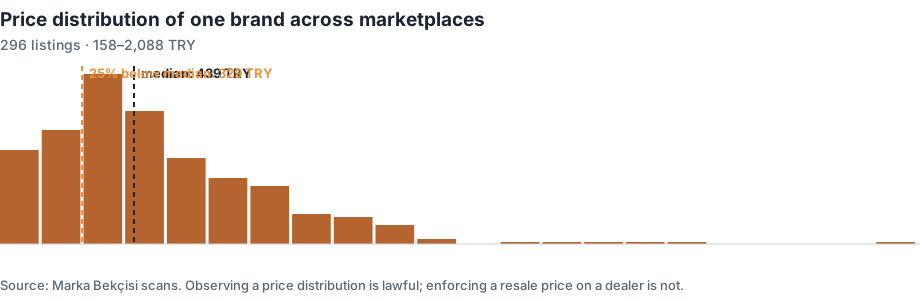
In our own scan of a single brand across five Turkish marketplaces, observed prices ranged from 158.00 to 2,088.32 Turkish lira. A spread that wide is common and it is data, not a case. The range reflects different sourcing channels, promotional calendars, and seller cost structures. You should record the distribution as a factual snapshot. Do not interpret the low end as proof of counterfeiting or the high end as proof of gouging; both conclusions go beyond what the price alone can show.
What the spread is good for is locating the entry point of out-of-channel stock. The listing far below the median is usually where product left your channel, and the way to confirm that is a purchased sample checked against your shipment records. You buy the unit, capture the lot code or serial number, and match it to the distributor or warehouse that last held that batch. That match tells you which partner leaked stock or which logistics leg was compromised. Price pointed you to the listing; the physical sample proves the breach.
Treat price as an input to a channel investigation, never as a demand you make of a seller or of a platform. A demand letter that cites "unauthorised low price" has no legal standing under Turkish IP or competition law. The actionable step is the test purchase and the batch trace. Once you identify the leaking partner, you address the breach through your distribution agreement, not through a marketplace takedown form. The platform remains a passive host; your leverage sits inside your own supply contracts.
More on this: how to find every seller of your brand in Turkey.
It will not tell you who is selling
No Turkish marketplace publishes a consolidated list of the sellers offering your brand, and the five large ones do not expose seller identity in the same way as each other. You cannot download a single report that shows every storefront carrying your products across Trendyol, Hepsiburada, Amazon.com.tr, n11 and Çiçeksepeti. Each platform structures its public data differently, so a search on one marketplace yields a format that does not match the others. Brand owners often assume a marketplace dashboard will reveal the full seller universe, but the platforms treat seller identity as operational data they are not obliged to aggregate for you. The practical result is that you must build and maintain your own master list before you can act on any finding.
Hepsiburada returns the seller name in its listing data, while Trendyol's search results carry only a seller identifier and the name has to be read from the product page. On Hepsiburada the merchant name appears directly in the feed or search export, so you can capture it without opening each product detail. On Trendyol the search layer shows an internal identifier instead, forcing you to visit every product page to read the visible store name. This asymmetry means a single scraping script cannot treat both marketplaces identically. Teams that write one parser for all five sites usually miss the Trendyol seller names entirely, leaving gaps in the enforcement list.
Every enforcement route depends on a list you supply: complaints name specific listing addresses, and Trendyol's approved-supplier list has to be filled with store links you already hold. You cannot file a takedown or a brand-protection request with a vague description such as "unauthorised sellers of our brand". The complaint form requires the exact URL of each infringing listing, and Trendyol's whitelist process asks for the store links of the sellers you want authorised. If you do not have those URLs in hand, the platform will not generate them for you. Many brands discover this only after drafting a notice and finding the submission blocked by a mandatory URL field.
Trendyol also caps how many links a single notice can carry: up to 10 for a trademark claim and 5 for image or design, with a 36-hour review. A long list has to be prioritised before it is filed. If you identify fifty unauthorised listings, you cannot paste them into one form and expect a single decision. You must split the URLs into batches that respect the ten-link limit for trademark claims or the five-link limit for image and design claims, then submit each batch separately and wait for the 36-hour review window on each. Brands that ignore the cap submit oversized notices that are rejected or truncated, wasting the review cycle on listings that never reach the moderation queue.
Scanning five Turkish marketplaces by hand takes days, and the result goes stale within weeks as sellers appear and disappear. Producing and refreshing that list is the work we do. A manual sweep across Trendyol, Hepsiburada, Amazon.com.tr, n11 and Çiçeksepeti consumes multiple working days even for a modest catalogue. By the time the spreadsheet is finished, new sellers have already launched listings and others have closed or changed store names. The data you acted on last month no longer reflects the live marketplace. Continuous monitoring is the only way to keep the enforcement list current enough for the URL-dependent complaint forms.
If you would rather not count these by hand, we run the scan across all five marketplaces and send the report free: free scan.
Frequently asked questions
Does a Turkish marketplace decide whether a product is counterfeit?
Turkish marketplaces do not decide whether a product is counterfeit. Under Article 14 of the e-commerce regulation their review is limited to the documents submitted, so they compare paperwork rather than examining the product. Both sides sign a declaration accepting liability if their claim proves untrue, which places the risk on whoever asserts.
The listing was removed. Does that mean I won?
Removal within 48 hours means your filing was procedurally valid, not that infringement was established. The seller can object with an invoice and supply chain documents, and a compliant objection puts the listing back within 24 hours.
Can I ask a marketplace to enforce my dealer agreement?
A marketplace is not a party to your dealer agreement and cannot enforce it. What a marketplace acts on is documents: once your trademark record is approved on Trendyol, sellers who cannot upload an authorised-seller document have their listings closed after 36 hours, while sellers who can document their supply keep selling.
Will a marketplace stop sellers undercutting my price?
A marketplace will not stop sellers undercutting your price, and you could not lawfully ask it to. Imposing a fixed or minimum resale price on independent sellers is contrary to Turkish competition law and a recommended price cannot be made binding. Use the price spread to locate where out-of-channel stock entered instead.
Can I get a list of everyone selling my brand from the platform?
No Turkish marketplace publishes a list of everyone selling your brand, and each exposes seller identity differently. Every enforcement route nonetheless depends on that list, because complaints name specific listing addresses and the approved-supplier list is filled with store links you must already hold.
Sources
- Regulation on Electronic Commerce Intermediary Service Providers and Electronic Commerce Service Providers — Official Gazette 29 December 2022, no. 32058 — complaint art. 12, objection art. 13, reinstatement within 24 hours, bar on a second complaint and document-limited review art. 14
- Industrial Property Law No. 6769 — full text (PDF, Turkish) — Article 152, exhaustion of rights
- Hepsiburada — Procedure for Intellectual and Industrial Property Rights Complaints (Turkish) — Rights holders file by notary or KEP; sample liability declaration templates for complaint and objection
- Trendyol Seller Information Centre — Infringement Notices (Turkish) — Up to 10 links for trademark and 5 for image or design; 36-hour review
- n11 Brand Protection Centre (Turkish) — Membership requirement before an infringement notice can be filed
- Turkish Competition Authority — Guidelines on Vertical Agreements (PDF, Turkish) — Framework on resale price maintenance in distribution systems
Related guides
Turkey's 48-Hour Marketplace Takedown Rule: How IP Complaints Work on Turkish Platforms (2026)
The Turkish e-commerce regulation gives marketplaces 48 hours to act on a complete IP complaint. What the five mandatory elements are, why an incomplete complaint never starts the clock, how the seller's objection brings a listing back within 24 hours, and the one-shot rule after that.
9 September 2026 · 12 minn11 Brand Protection Centre: Membership and Filing an Infringement Notice (2026)
n11 does not accept direct IP complaints. You join the Brand Protection Centre first: the documents, the address, the KEP alternative and the filing flow.
20 September 2026 · 12 minÇiçeksepeti Brand Complaints: What to Do When There Is No Portal (2026)
Çiçeksepeti has no public brand-owner portal. The notary and KEP route produces the same legal effect: the channel, the address and the required elements.